Everything measured on the Voynich Manuscript
The language tests, the stroke runs, the failed Genesis fit, the three readings, and what is still open.
Wallet: bc1qtphsftylaj9s0wvapvs50ltsl5saalny4dhyv9
Everything measured on the Voynich Manuscript, positive and negative at the same size. A proposed decipherment has to clear all of it.
1Against ten languages
Key-free measures only — word length, letter entropy, first and last letter fixedness, immediate repeats, types, hapax. The Voynich Manuscript stands 2.7 to 4.4 of the languages' own standard deviations from every one of them, where they sit 0.6 to 2.7 from each other. Nearest is Middle High German; turned or mirrored, nearest is Hebrew at 3.4.
| Text | Letter entropy h1 | Conditional h2 |
|---|---|---|
| Old Czech (Dalimil, Hus) | 4.77 | 3.53 |
| Czech (1613 Bible and later prose) | 4.69 | 3.60 |
| Church Slavonic, Glagolitic (Zographensis) | 4.68 | 3.29 |
| Hebrew (Genesis, Exodus, consonantal) | 4.23 | 3.47 |
| Occitan | 4.22 | 3.21 |
| Early New High German | 4.18 | 3.23 |
| Italian | 4.12 | 3.15 |
| Latin | 4.05 | 3.26 |
| Old French | 4.03 | 3.18 |
| Middle High German | 4.00 | 3.04 |
| MS, compound glyphs as one sign | 3.87 | 2.35 |
| MS, EVA as transliterated | 3.86 | 2.12 |
| MS, the same turned (words reversed, order reversed) | 3.85 | 2.29 |
Corpora fetched from Wikisource: Old Czech (Dalimil, Hus's Dcerka), Hebrew (Genesis, Exodus, consonantal), Church Slavonic in Glagolitic (Codex Zographensis), and the rest.
2The stroke runs stop at four
Runs of plain strokes closed by the hooked stroke, counted with the hook, over the whole book:
| Run | 1 stroke | 2 | 3 | 4 | 5 |
|---|---|---|---|---|---|
| Count | 137 | 1,719 | 4,131 | 165 | 1 |
They stop at four exactly as a scribe's numerals do — j, ij, iij, iiij. Read as powers of four the sequence runs 4, 16, 64, 256, 253, 241, 193, 1, closing on the order-8 subgroup of the field. Four-stroke runs follow a 121 times and o 41 times, together 162; and one-stroke runs follow a 121 times as well — the same count.
The 121 words with a four-stroke run after a sum to 6,562 = 25 × 257 + 137: residue 137 EYE OF HORUS, quotient 25 = Δ².
3Rare glyphs keep strict company
- b is always last, after e — 15 of 15.
- u is always last or alone — 8 of 8.
- v sits on f57v, 10 of 11.
- x sits on the rosettes, f57v and f66r.
- There is no a followed by u anywhere in the book, against 4,279 instances of a followed by two strokes. Occitan runs 97.9 "au" per 10,000 letters, Early New High German 86.1, Latin 54.8, Old Czech 1.0.
Sparse is not absent. A letter that appears rarely but under a strict rule is data, in the way Q is data in English.
4The Genesis fit, which failed
Negative result
Genesis 1–13 was fetched in Hebrew and reduced to 337 verses with their gematria, counts checked. Solving for additive glyph values so that the Voynich Manuscript's entries, lines or words equal the verses or words of Genesis in order gives zero exact hits, no better than a shuffled control, and no solution in GF(257).
The fitted values are still data, and read by the field they are: k → 78 GENESIS · d → 256 · u → 129 · a → 228 = RITO⁻¹ · m → 111 · p → 233 · s → 139 · i → 232 · y → 244; weighted sum ≡ 2.
5What the three readings give
Three readings were computed over all 322 starred entries of the Voynich Manuscript: upright, mirrored (each line right to left, lines in order) and half-turned (the whole entry reversed). Letter sums and cells never change; the φ part does.
| Reading | Dated entry points, years 1–1420 | All 322 together |
|---|---|---|
| upright | 94 | 253 |
| mirrored — the reading | 80 | 105 |
| half turn | 78 | 243 |
The mirror is not chosen because it scores highest on this measure. It is chosen because it is the only one that puts 913 and 203 in order at entry 6.
6What is still open
- Lines inside an entry: down only (203), or up as well (192).
- Ring order on a zodiac page. Every result takes the transcribers' list order; no other order has been tested.
- Three of the five starless figures do not fall on a new Moon.
- Capricorn and Aquarius are lost with folio 74, so mid-December to early February has no figure to land on.
- Whether the faint second line above the long P of f85r1 is real.
- The centre month-words, and whose hand wrote them.
- Whether the holes are the skin's or the makers': a stretched skin gives the same ovals, and the ratios do not tell the two apart.
- f14's right rim, which is not seen; and the holes of f36, which are ragged, so the skin of f36 and f37 cannot be tested.
- Whether the three glyphs of f49v's column are read rightly: the page has not been read at full size.
- A head in the water at the foot of f80v: 232 women, or 233.
7The women of the bathing pages
Quire 13, f75r to f84v: twenty sides, nineteen with pictures and one of text, all in one hand. The women were counted by eye from the page images and enlarged crops, group by group. The transcribers give a count for four of the sides; the counts here are the same on all four.
| Side | Women | The transcribers' count | Green % | Blue % | |
|---|---|---|---|---|---|
| f75r | 135 | 14 | 14 | 6.879 | 0.050 |
| f75v | 136 | 29 | 0.690 | 0.113 | |
| f76r | 137 | text only | 0.007 | 0.000 | |
| f76v | 138 | 5 | 0.001 | 0.007 | |
| f77r | 139 | 4 | 0.011 | 0.149 | |
| f77v | 140 | 7 | 0.030 | 0.153 | |
| f78r | 141 | 15 | 4.062 | 0.063 | |
| f78v | 142 | 9 | 9 | 2.132 | 0.199 |
| f79r | 143 | 7 | 7 | 1.976 | 0.082 |
| f79v | 144 | 4 | 3.972 | 0.063 | |
| f80r | 145 | 16 | 0.046 | 0.520 | |
| f80v | 146 | 12 | 0.015 | 0.475 | |
| f81r | 147 | 13 | 5.482 | 0.119 | |
| f81v | 148 | 16 | 16 | 3.779 | 0.011 |
| f82r | 149 | 15 | 4.008 | 0.199 | |
| f82v | 150 | 8 | 4.241 | 0.352 | |
| f83r | 151 | 5 | 0.107 | 0.175 | |
| f83v | 152 | 4 | 3.207 | 0.048 | |
| f84r | 153 | 33 | 5.039 | 0.200 | |
| f84v | 154 | 16 | 0.007 | 0.808 |
By the field 232 has dlog 238, ring 2, fold 25, inverse 185, reflection 12; 0232 reaches 6174 by 2997, 7173, 6354, 3087, 8352, 7 steps with the own step. As days, 232 is 7.856 synodic months.
The last page, f116v, has in its margin a four-legged animal over a naked woman with a ring of loops round her head, beside a hole in the vellum. In the bathing pages the same pair stands once, on f80v: an animal over a woman with a band of loops over her head. She stands in a tub and holds a red ring; the woman of the last page has neither.
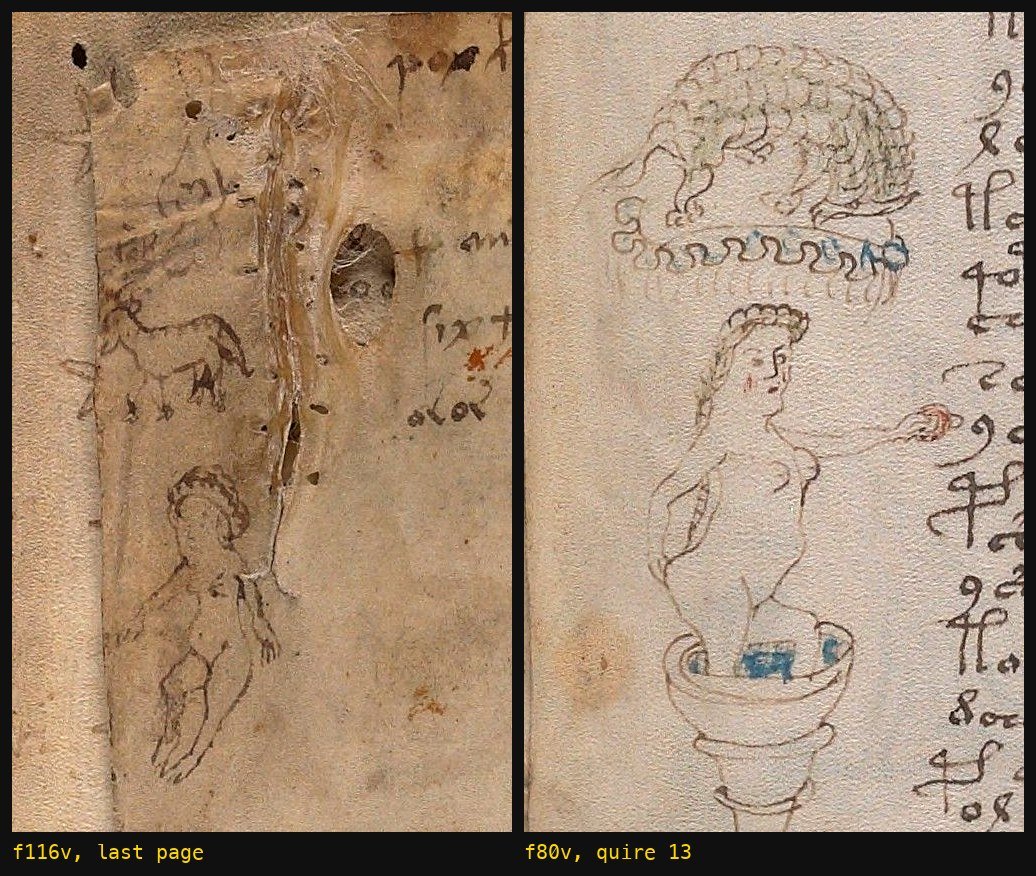
Left, the last page's margin: the seam, the animal, the woman. Right, f80v: the beast over the woman with the ring.
Counted by eye at 1,536 px. Not settled: a head in the water at the foot of f80v, which would make 233; the crowded pools of f84v and f75v. The women against the green share of the page r = +0.228, against the blue +0.173.
8The openings in the vellum
Every one of the 209 page images was looked through for holes, rifts and sewing holes, and 190 places were looked at enlarged. There are three kinds, and they do not behave alike.
| Kind | Where | Cuts letters | Same place on neighbouring leaves |
|---|---|---|---|
| Holes and sewn rifts the pen goes round | eighteen leaves through the book | no | no |
| Splits along folds and at the gutter | the foldouts: PDF 156, 157, 158, 130, 131 | no | |
| Small ragged holes | the front, f1 and f2; the back, f113 to f116 | yes, on f115r and f116r | yes |
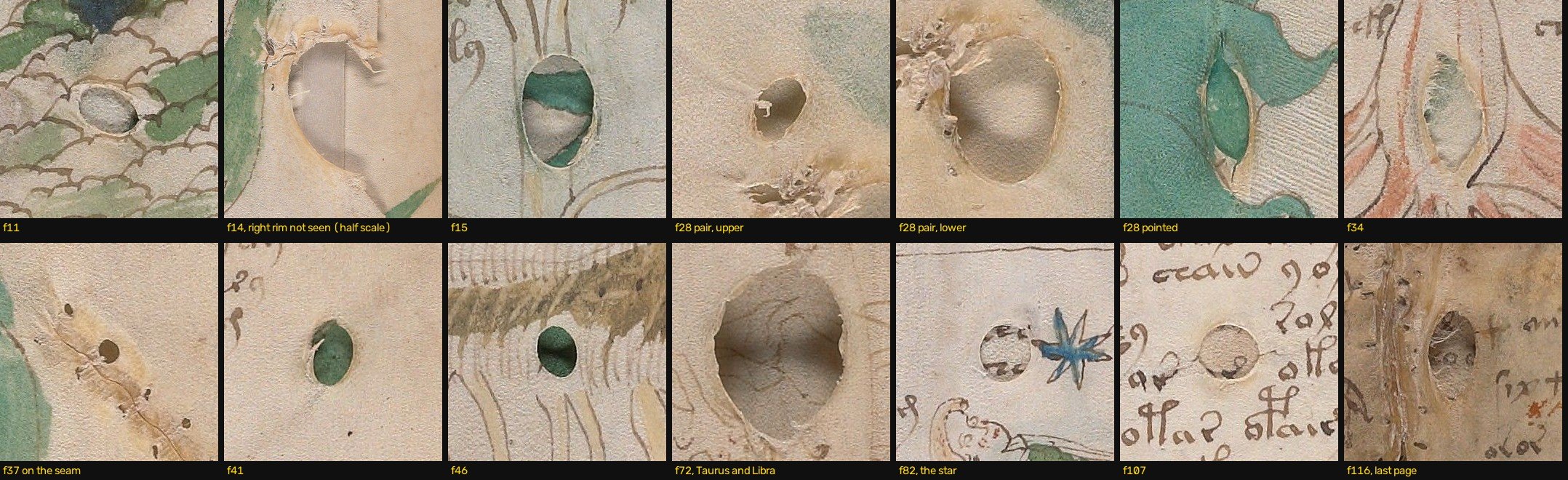
The holes at full size and one scale, f14 at half. On f82 a star is drawn on the rim.
| Leaf | Kind | Sewing holes | What the pen or the brush does | |
|---|---|---|---|---|
| f9 | 19 | sewn rift, open | 7 | line 8's last word ends at its lip |
| f11 | 23 | oval hole | in the plant's scales, the scale lines go round it | |
| f14 | 27 | a bite at the edge: the left rim clean, the head torn, the right rim not seen | bare ground beside the plant; skin lifted at its head | |
| f15 | 29 | oval hole | the stem's two lines part round it; on the verso a painted leaf is drawn round it | |
| f28 | 55 | two holes close together, a rag of skin between | bare ground beside the plant; the smaller 37 by 31 | |
| f28 | 55 | pointed oval hole | inside a painted leaf, the leaf's vein runs to it | |
| f34 | 67 | oval hole | the root is drawn round it on both sides of the leaf | |
| f36 | 71 | sewn rift | 13 | across the root at the foot; the root's paint on both lips |
| f36 | 71 | a torn place with rags of skin, no oval rim | in the plant, a leaf's outline drawn to its rim | |
| f36 | 71 | a scar with a lifted flap, a small hole in it | bare ground | |
| f37 | 73 | sewn tear | 11 | bare ground between the leaves and the edge |
| f37 | 73 | round hole on the seam | midway between two sewing holes | |
| f38 | 75 | sewn rift, part open | 8 | inside the painted leaf |
| f41 | 81 | oval hole | right of the first paragraph's last lines, which stop short of it | |
| f46 | 91 | round hole | in the root; on the verso the root's two horns are drawn either side of it | |
| f52 | 103 | ragged, no clean rim | bare ground at the root's side | |
| f72 | 130 | oval hole | Taurus on the recto, Libra on the verso; the ring of text meets it | |
| f82 | 149 | round hole | a blue star drawn on its rim, a line led from the star to the pipe | |
| f82 | 149 | sewn rift | 24 | through the green pool at the foot, the green on both lips |
| f89 | 162 | sewn slit | 12 | line 13 stops before it and goes on after it |
| f99 | 175 | a sewn rift standing open, bent like a comma | 11 | the text goes round it on both sides of the leaf |
| f107 | 191 | round hole | two lines part round it on the recto, one on the verso | |
| f116 | 205 | oval hole | the writing at the head begins beside it | |
| f116 | 205 | sewn seam, a slit open on it | 14 | the animal beside it, the crack ends at the woman's neck |
The stem of f15, the roots of f34 and f46, the leaf of f28 and the scales of f11 are drawn round their holes; the text of f99, f107, f41 and f72 parts round theirs. f11 and f14 are the two halves of one skin, and so are f36 and f37; four leaves of quire E carry openings. Every one of the five hands has a leaf with one.
The last page has a seam, a hole and a slit: the seam runs down the margin with sewing holes either side, the oval hole stands beside it, and the slit stands open on the seam, its crack ending at the woman's neck. Counted one by one at full size the sewing holes are 7 on f9, 11 on f37 and 12 on f89; none holds thread.
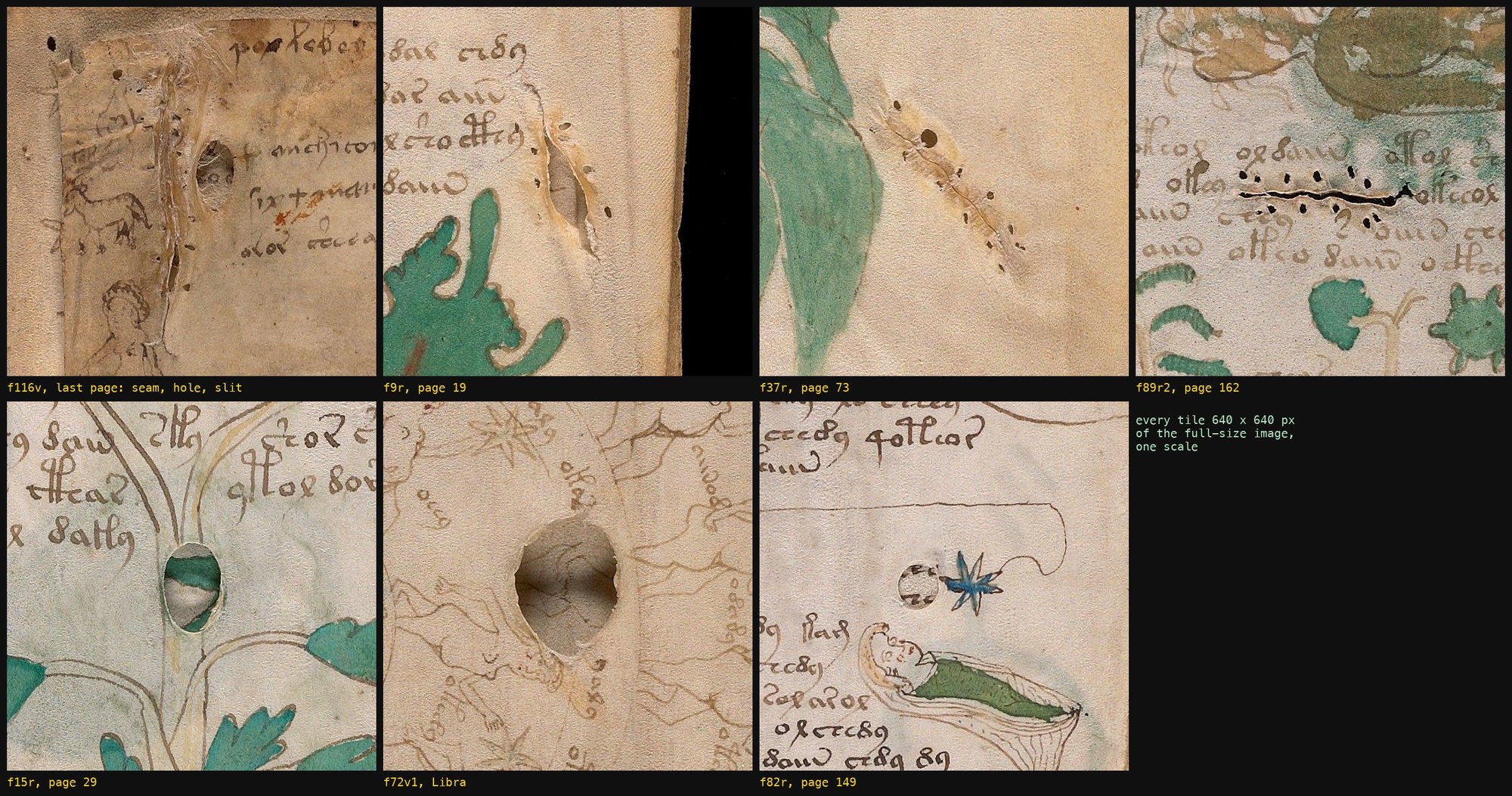
The last page's seam, hole and slit beside the rifts of f9, f37 and f89 and the holes of f15, f72 and f82.
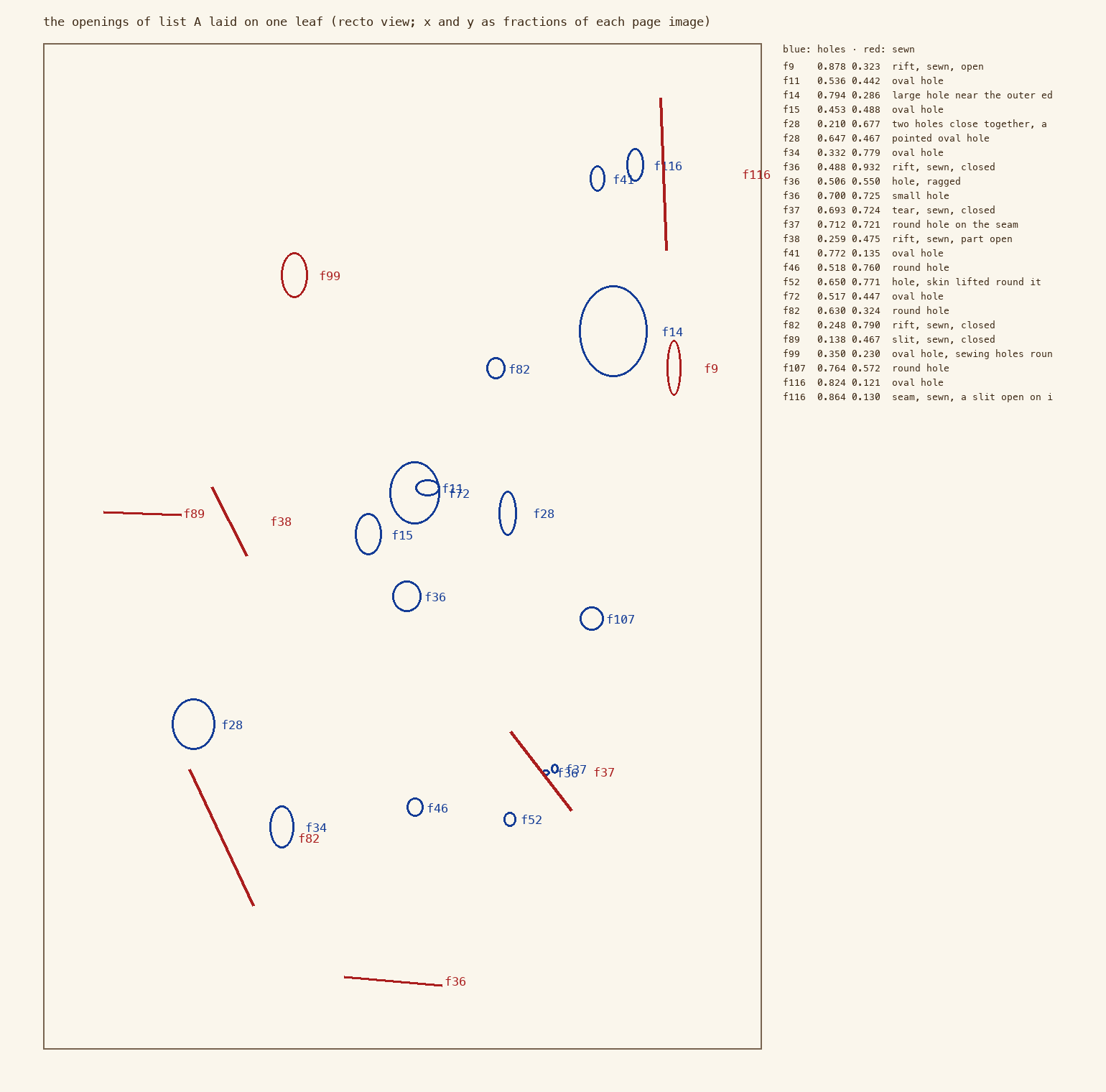
Every opening laid on one leaf, recto view: blue the holes, red the sewn.
No one word stands against every opening. Of the 26 words hard against one, 25 are different; twelve begin with o, where 22.9 % of the book's words do, and six with ok, where 6.5 % do. The line that ends at f15's hole sums to 255 outright and the last page's line to 128 outright, and 255 × 128 = 127 × 257 + 1: the two are inverses.
9The holes measured at full size
Eighteen page images were fetched at full size from the Beinecke. Thirteen holes have clean rims; each was outlined on a gridded enlargement and an ellipse fitted to the outline.
| Hole | Long | Short | Short over long | ± | Leans from the upright |
|---|---|---|---|---|---|
| f28 pointed | 133.6 | 56.2 | 0.421 | 0.024 | 10.4° |
| f34 | 152.7 | 74.9 | 0.491 | 0.022 | 9.6° |
| f116 | 121.4 | 65.8 | 0.542 | 0.047 | 0.7° |
| f41 | 86.0 | 54.5 | 0.633 | 0.041 | 1.6° |
| f15 | 151.8 | 98.2 | 0.647 | 0.039 | 1.9° |
| f46 | 72.2 | 51.9 | 0.719 | 0.051 | 16.6° |
| f37 on the seam | 34.9 | 25.2 | 0.724 | 0.106 | 27.6° |
| f28 upper of the pair | 87.0 | 64.0 | 0.735 | 0.043 | 29.1° |
| f28 lower of the pair | 203.2 | 156.1 | 0.768 | 0.019 | 0.3° |
| f11 | 85.1 | 65.6 | 0.770 | 0.044 | 71.6° |
| f72 | 229.0 | 189.2 | 0.826 | 0.028 | 0.1° |
| f82 | 78.2 | 69.3 | 0.887 | 0.085 | 2.0° |
| f107 | 83.6 | 74.5 | 0.891 | 0.048 | 84.2° |
f14's right rim is not seen, and its ratio lies between 0.62 and 0.78. Both holes of f36 and the hole of f52 are ragged. f99 is a sewn rift standing open. Laid one over another at one area the last page's hole and f15's overlap 0.893; its slit and f9's 0.713.
Read as the Sun's image, and as tilts by the 210-gon's step, the holes are on The Sky.
10The column in the margin of f49v
Down the left margin of f49v stands one glyph to a line, 26 glyphs beside 26 lines. Three of the glyphs are outside the transliteration's letters and carry its numbers 140, 192 and 164.
- The run o · y e @140 stands three times, from glyphs 2, 10, 17; its second glyph is r once and @192 twice.
- The numerals 1 to 5 are written beside the first run, in another hand.
- Line 4, beside y and numbered 3, sums to 210 outright; all 26 lines sum to 7778 ≡ 68.
- The letters on each line follow the width the plant leaves: r = +0.948 over the 23 lines that are not a paragraph's last, at 20.0 px a letter.
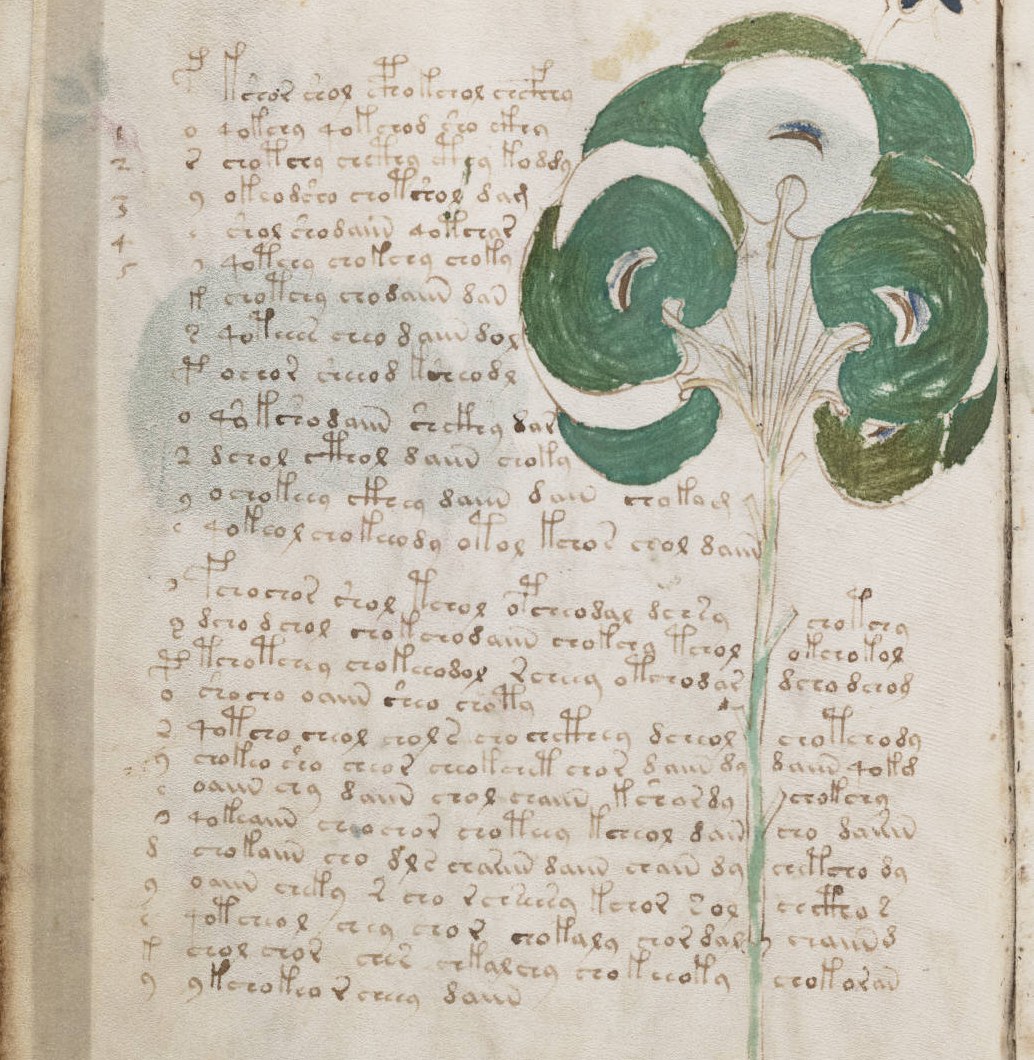
f49v: the column, the numerals beside its first run, and the text fitted to the plant.
How the column reads by the field is on The Text.
11The five stars and the manuscript
The norm of every point of the plane, drawn as a picture, has five stars; what they are is on The Field. The manuscript draws the same figure. The left flower of f90v1 is a cross of four arms at right angles, turned as the picture's four stars are turned about its middle. Four of the sewn rifts lean along the picture's own directions. The foldout of the rosettes counts as the picture counts, five and nine.
The flower of f90v1
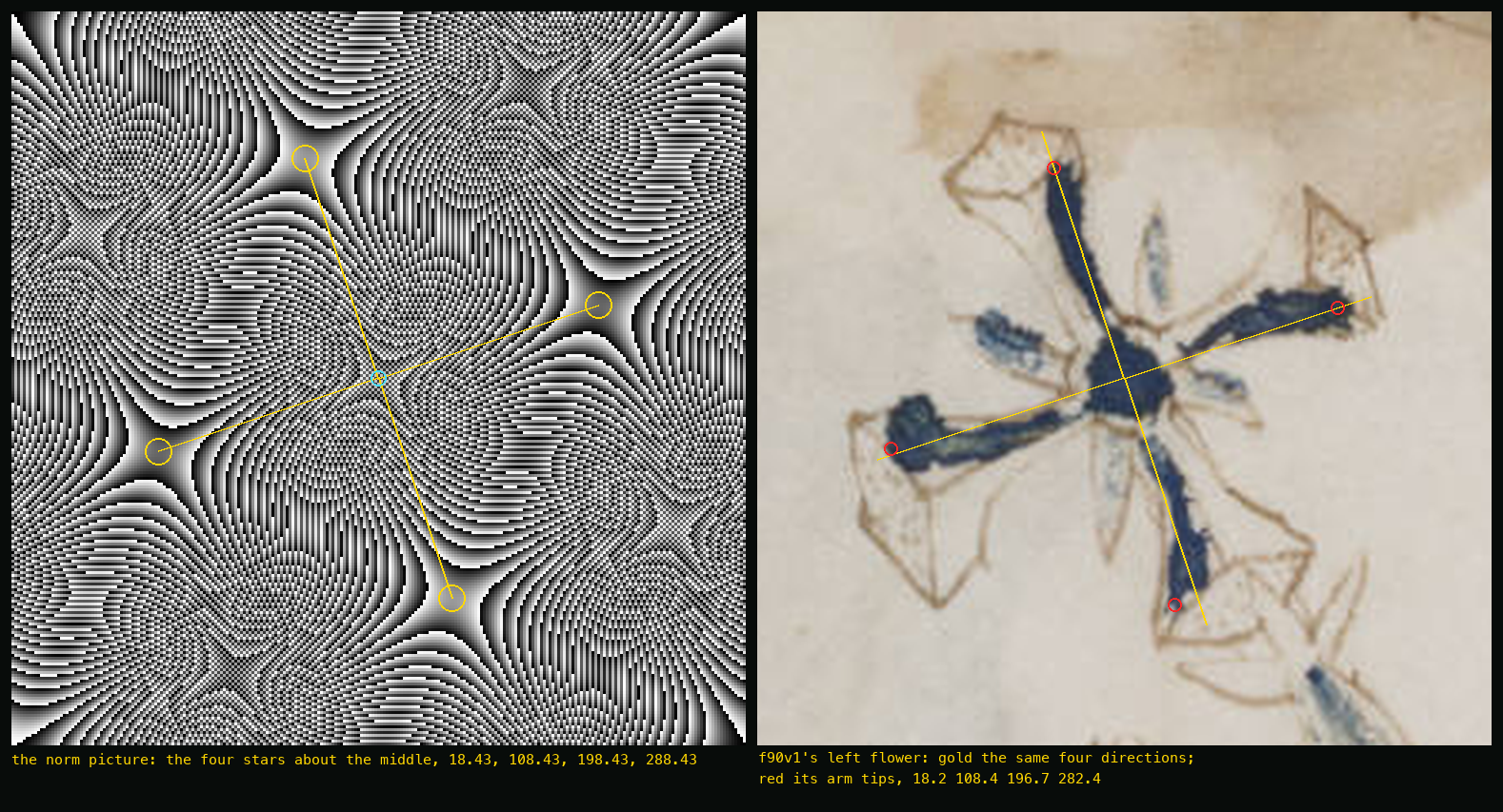
Left, the four stars joined to the middle of the picture. Right, f90v1's left flower: gold the same four directions, red its arm tips.
| Directions, as seen | |
|---|---|
| The four stars about the picture's middle | 18.43°, 108.43°, 198.43°, 288.43° |
| f90v1's left flower, its four arms | 18.2°, 108.4°, 196.7°, 282.4° |
f90v1's left flower has four dark arms at right angles. As seen on the page they point at 18.2°, 108.4°, 196.7°, 282.4°. The four stars stand about the middle of the picture at 18.43°, 108.43°, 198.43°, 288.43°: a square turned arctan ⅓. Arm by arm the flower stands 0.2°, 0.0°, 1.7° and 6.0° from the stars. An arm's tip is read to 3 px, which at the arm's reach is 2.5°.
Both are crosses at right angles: the flower's neighbouring arms stand 90.3°, 88.3°, 85.7°, 95.7° apart, and the form's two lines have slopes whose product is −1. The square fitted to the four arm tips is turned 16.4° and the stars' square 18.43°; on the four arms together the measure is good to 1.2°.
The flower's turn is the stars' turn about the middle. The picture has two other directions of its own, from star to star, arctan ½ = 26.57°, and the star's own arms, 31.72°; the fitted square stands 10.2° and 15.3° from those.
Why they fit
The norm's first differences are (2a + b, a − 2b), a matrix whose square is 5. So the stars stand at the five multiples of (2, 1)/5 of the picture: the seed, and the four units 1, φ, −1 and −φ, each over √5. In the field of five φ is 3, and 3² = −1: φ is that field's quarter turn, as 16 is the quarter turn of 257. Four units a quarter turn apart are a square. From the picture's middle they stand at (3, 1), (1, 3) and their opposites, in tenths of the side, so the square is turned arctan ⅓.
The picture's angles are one family, all from φ. The star's own arm is arctan(1/φ) = 31.72°. Twice that is arctan 2 = 63.43°. Its complement is arctan ½ = 26.57°, the step from star to star. And 45° less that is arctan ⅓ = 18.43°, the square's turn.
From Prague's old town, 50.0875° N, in 1420 the midsummer noon Sun stands at 63.43°, which is arctan 2: a post's shadow is 0.50017 of its height, half. Its distance from the zenith is 26.57°, and 45° less that is 18.43°. The flower's arms stand at 18.2° and its quarter turns: the flower is turned as the square is, and the square is turned by the midsummer Sun at Prague.
The noon ceiling is arctan 2 exactly at 50.0797° N, and the longest day is 10φ hours exactly at 50.0951° N. Midway between the two is 50.0874° N. The old town stands at 50.0875° N.
The Sun and the stars at the picture's angles
From the same place and year: the days on which the noon Sun stands at each of the picture's angles, and of the stars of the third magnitude and brighter the one that crosses the meridian nearest it.
| Angle | In the picture | The noon Sun, 1420 Julian | Star | On the meridian | From the angle |
|---|---|---|---|---|---|
| 18.43° | arctan ⅓, the square's turn | 5 Jan, Capricorn 23 · 19 Nov, Sagittarius 6 | β Leporis | 18.53° | +0.10° |
| 26.57° | arctan ½, from star to star | 5 Feb, Aquarius 25 · 19 Oct, Scorpio 5 | δ Corvi | 26.62° | +0.05° |
| 31.72° | arctan(1/φ), the star's arm | 19 Feb, Pisces 9 · 5 Oct, Libra 21 | Spica | 31.83° | +0.11° |
| 45.00° | 45°, the half of the right angle | 24 Mar, Aries 13 · 1 Sep, Virgo 17 | β Ophiuchi | 44.91° | -0.09° |
| 50.15° | the arm and the turn together | 7 Apr, Aries 26 · 18 Aug, Virgo 4 | γ Aquilae | 49.26° | -0.89° |
| 58.28° | arctan φ, the star's other arm | 4 May, Taurus 22 · 22 Jul, Leo 8 | β Arietis | 57.79° | -0.49° |
| 63.43° | arctan 2 | 12 Jun, the solstice, the highest noon of the year | δ Leonis | 63.55° | +0.11° |
Spica, of the first magnitude, crosses the meridian at 31.83°, beside the star's own arm, 31.72°. Zubenelgenubi crosses at 26.39°, beside arctan ½. The noon Sun stands at arctan ½ on 19 October, Scorpio 5: the day and the degree of the eclipse of 1408 on The Sky.
The angles are the Sun's. The pole stands in the north at 50.09°, the latitude, and in 1420 the North Star circles it 3.86° off, between 46.23° and 53.95°. The star's arm and the square's turn together are 50.15°. Kochab crosses the meridian in the north at 63.57°, beside arctan 2.
The word mark of an Ethiopian prayer book
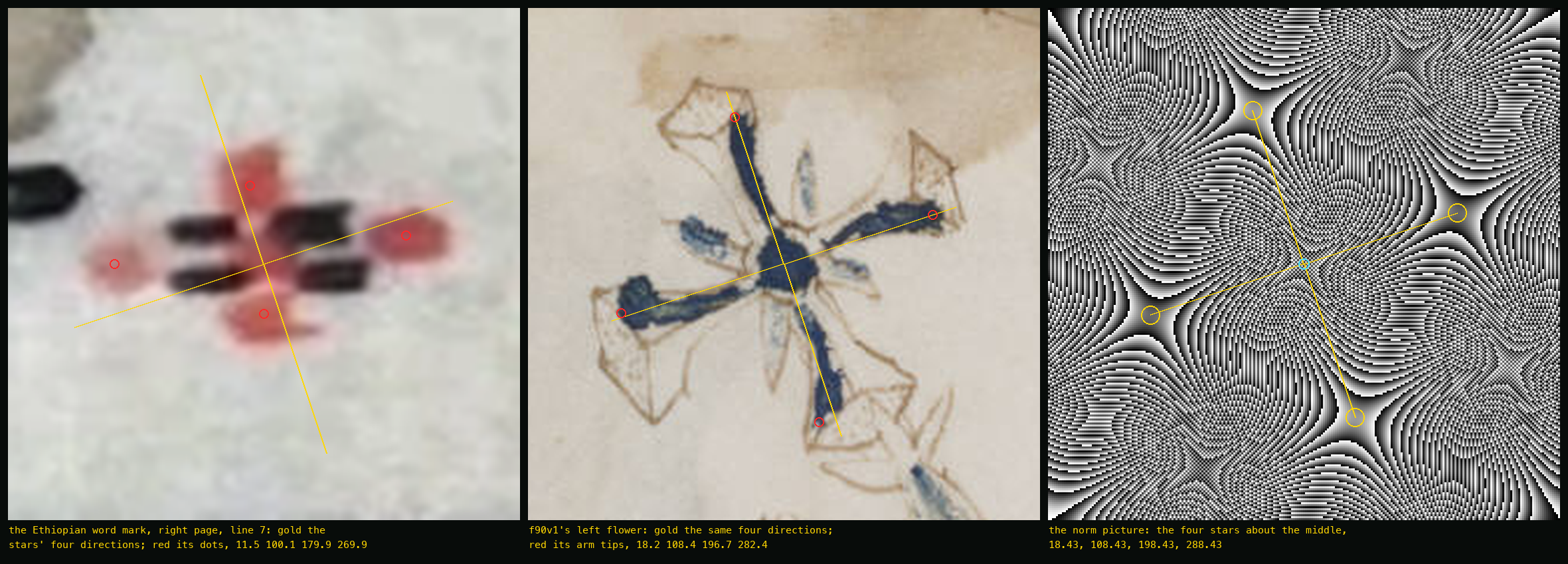
Left, the red-and-black word mark of an eighteenth-century Ethiopian prayer book: gold the stars' four directions, red its four dots. Middle, f90v1's left flower. Right, the four stars.
The Ethiopian book parts its words with a mark of nine pieces three by three, a red cross of five dots with four black bars in its corners. Ten of these marks were measured as the flower was. Their arms stand on average at 8.83°, 106.32°, 184.48°, 275.23°, and every cross is turned anticlockwise, +8.71° on average as seen, good to 1.33°, and +8.24° against its line of writing.
From Gondar in 1750 the December noon Sun stands 36.08° from the zenith, and 45° less that is 8.92°; from Prague in 1420 the June noon Sun stands 26.57° from it, and 45° less that is 18.43°. The ten marks, the precession carried forward from 1420 and the noon Sun from Ethiopia are on The Field.
The rifts' lean
| Rift | Lean from the upright | The picture's direction beside it |
|---|---|---|
| f9 | 24.6° | star to star, 26.57° |
| f36 | 85° | |
| f37 | 37.8° | |
| f38 | 27° | star to star, 26.57° |
| f82 | 25° | star to star, 26.57° |
| f89 | 87.6° | |
| f99 | 19.0° | the stars from the middle, 18.43° |
| f116 | 1.5° |
The sewn rifts lean from the upright. f9 leans 24.6°, f38 27° and f82 25°: the step from star to star is arctan ½ = 26.57°. f99 leans 19.0°: the stars stand from the middle at arctan ⅓ = 18.43°. f37 leans 37.8°. f116's seam stands upright, 1.5°. f36 and f89 run across the page, 85° and 87.6°. f9, f37, f89 and f116 are read at full size, the others from the PDF's image.
The openings on the picture
Each of the 24 openings was laid on the picture by its place on its page, the page's width and height taken as the picture's, and its distance to the nearest star taken, the picture's side being 1. Nearest stand f52's hole, 0.058 from 154 + 206φ; f99's rift, 0.059 from 103 + 51φ; f28's pair of holes, 0.078 from 51 + 154φ; and f46's hole, 0.091 from 154 + 206φ. f36 and f37 are one skin, and three of their openings stand together by 154 + 206φ, at 0.120, 0.125 and 0.137. Over the 24 the mean is 0.1687.
| Leaf | Opening | Place on its page | Nearest star | Distance |
|---|---|---|---|---|
| f52 | ragged, no clean rim | 0.650, 0.771 | 154 + 206φ | 0.058 |
| f99 | a sewn rift standing open, bent like a comma | 0.350, 0.230 | 103 + 51φ | 0.059 |
| f28 | two holes close together, a rag of skin between | 0.210, 0.677 | 51 + 154φ | 0.078 |
| f46 | round hole | 0.518, 0.760 | 154 + 206φ | 0.091 |
| f9 | sewn rift, open | 0.878, 0.323 | 206 + 103φ | 0.110 |
| f14 | a bite at the edge | 0.794, 0.286 | 206 + 103φ | 0.114 |
| f37 | sewn tear | 0.693, 0.724 | 154 + 206φ | 0.120 |
| f36 | a scar with a lifted flap, a small hole in it | 0.700, 0.725 | 154 + 206φ | 0.125 |
| f37 | round hole on the seam | 0.712, 0.721 | 154 + 206φ | 0.137 |
| f38 | sewn rift, part open | 0.259, 0.475 | 51 + 154φ | 0.138 |
| f89 | sewn slit | 0.138, 0.467 | 51 + 154φ | 0.146 |
| f28 | pointed oval hole | 0.647, 0.467 | 206 + 103φ | 0.167 |
| f36 | sewn rift | 0.488, 0.932 | 154 + 206φ | 0.173 |
| f107 | round hole | 0.764, 0.572 | 206 + 103φ | 0.176 |
| f82 | round hole | 0.630, 0.324 | 206 + 103φ | 0.186 |
| f116 | sewn seam, a slit open on it | 0.864, 0.130 | 0, the corner | 0.189 |
| f82 | sewn rift | 0.248, 0.790 | 51 + 154φ | 0.196 |
| f116 | oval hole | 0.824, 0.121 | 0, the corner | 0.213 |
| f34 | oval hole | 0.332, 0.779 | 51 + 154φ | 0.223 |
| f41 | oval hole | 0.772, 0.135 | 0, the corner | 0.265 |
| f36 | a torn place with rags of skin, no oval rim | 0.506, 0.550 | 154 + 206φ | 0.267 |
| f11 | oval hole | 0.536, 0.442 | 206 + 103φ | 0.268 |
| f72 | oval hole | 0.517, 0.447 | 103 + 51φ | 0.274 |
| f15 | oval hole | 0.453, 0.488 | 51 + 154φ | 0.277 |
Five and nine
The picture has five stars, the form's discriminant being 5; the rosettes foldout has five tubes. The picture holds nine places three by three: the corner star, four about the middle, and the star on the chequer at the centre. The foldout's nine rosettes stand three by three.
The flower's arms are read from the PDF's image; the Ethiopian marks from two photographs of the book. The rosettes have not yet been measured against the stars.
ProvenanceWhere every figure comes from
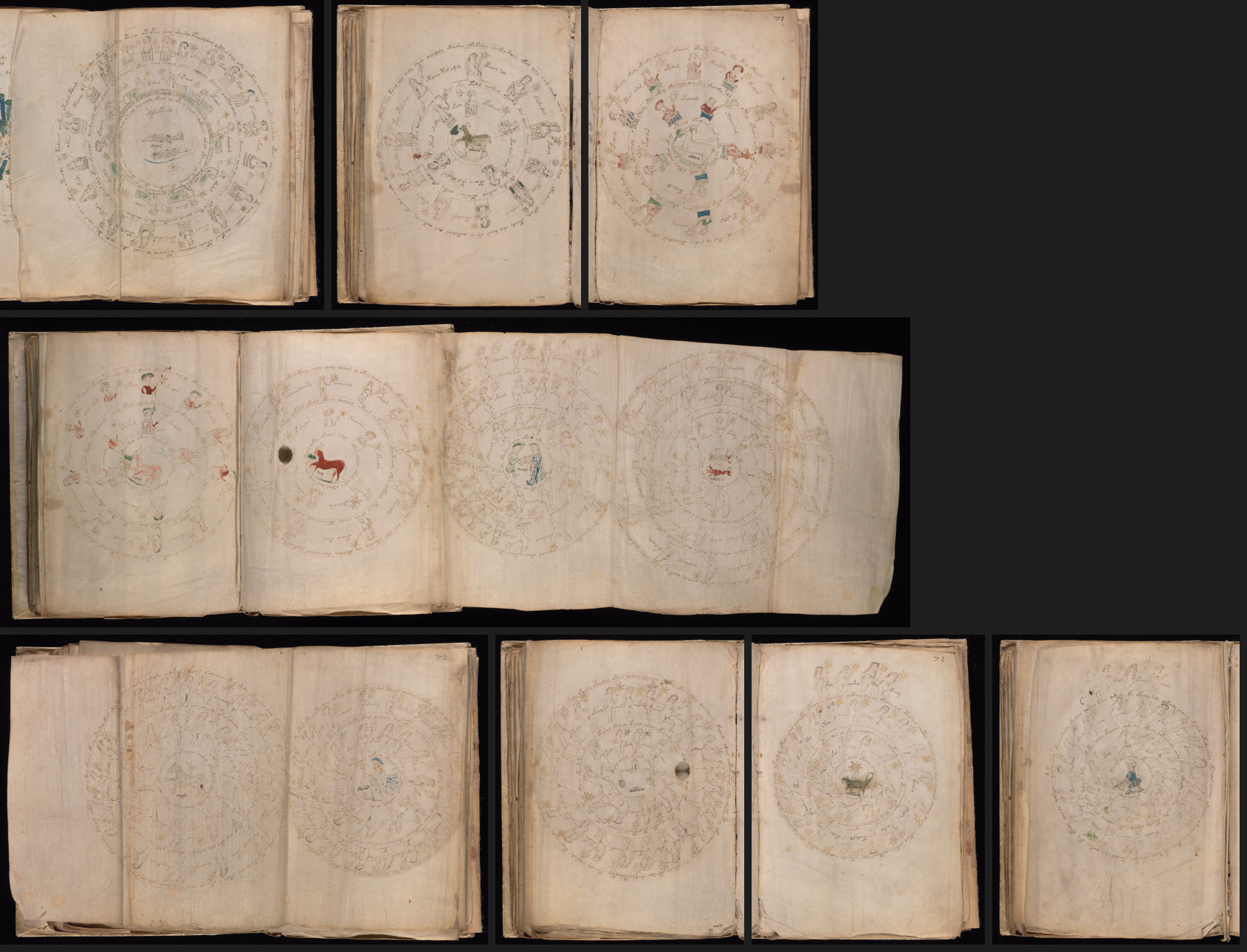
Beinecke MS 408: zodiac, astronomical and herbal pages
| Domain | Files |
|---|---|
| the field | emerald_tablet.json — 2,218 words over 257 cells |
| the text | ZL3b-n.txt — 227 sides, 5,385 lines, 36,278 words, 194,262 letters |
| the images | Voynich_Manuscript.pdf — 209 page images, and full-size Beinecke IIIF spreads |
| the figures | all_299_figures.json · tsv — twelve per-page tables, merged, per-page crops |
| the sky | solar · lunar eclipses 1301–1500, Prague visibility, Moon–Pleiades |
| the language | structure2.json — ten reference corpora |
| the bathing pages, the openings, f49v | voynich_87.json — the women by side, the 24 openings, the outlines at full size, the column and its sums; eighteen more Beinecke images at full size |
| the picture of the norms | norm_stars.json — the five stars, and the flower, the rifts and the openings beside them |
Every page on this site is made from those files. No number here is typed in by hand.