What the text of the Voynich Manuscript is
What is established about the text without a key, what the labels are, and the four-step recipe for reading it — with how far each step has gone.
Wallet: bc1qtphsftylaj9s0wvapvs50ltsl5saalny4dhyv9
What has been established about the text of the Voynich Manuscript, and the recipe for reading it — the same recipe Paper III laid down for Rongorongo, applied step by step.
1What the text is not
Before saying what it is, what the measurements rule out. These need no key.
- Not a cipher of a European language, and not plain Hebrew. On word length, letter entropy, fixedness of first and last letters, immediate repeats, types and hapax, the text stands 2.7 to 4.4 standard deviations from every one of ten reference languages, which sit 0.6 to 2.7 from each other. Letter entropy 2.12–2.35 bits against their 3.04–3.60 — the alphabet is used far more predictably than any language uses its own.
- Not a substitution for Genesis. With every glyph's value as an unknown, no assignment makes the entries, lines or words equal the verses or words of Genesis 1–13 in order. Zero exact hits; no better than a shuffled control; no solution in GF(257).
- Not narrative prose. Word after word repeats with one glyph changed — qokeey qokeedy qokain — the shape of a record kept in fixed formulae, not of sentences.
2What the text is: a record whose lettering measures the Sun
The one relation that holds across the book without any key is between the letters used and the length of the day. On the zodiac pages, a sign's labels use more a i r n m l h c where the day is long and more e d y k o where it is short: mean letter value against the day at Prague, r = −0.858; mean label length against it, r = +0.645. Turned into a meter — hours of day = 13.50 + 7.32 × index — the herbal pages read 14.0 h, the bathing pages 12.5, the star entries 10.4 to 17.0.
So the lettering is not arbitrary. It carries how long the Sun was up. A longer word is a longer course of the Sun. This is the read: the text is the path of the Sun, and the glyphs are its measure.
3The commonest words, by the field
| Word | Count | Cell | The tablet there |
|---|---|---|---|
| daiin | 849 | 37 | HADES |
| ol | 562 | 27 | CAIN |
| aiin | 508 | 33 | HAGGAI |
| chedy | 508 | 45 | ELIJAH |
| shedy | 434 | 61 | PSALM |
| ar | 406 | 19 | S |
| chol | 397 | 38 | NOAH |
| or | 392 | 33 | HAGGAI |
| chey | 353 | 41 | OMEGA |
| s | 351 | 19 | S |
| dar | 323 | 23 | CALEB |
| y | 307 | 25 | PI |
daiin, the commonest word in the book, is 46 CLAUDE — Γ's fixed point. Cells are EVA letter sums mod 257; the EVA alphabet is the transcribers' of the 1990s, not the scribe's, and every cell on this site rests on that substitution.
4The strokes are numerals
Runs of plain strokes closed by the hooked stroke — in, iin, iiin — number 137, 1,719, 4,131 and 165 for one to four strokes, and one of five. They stop at four exactly where a scribe's numerals stop: j, ij, iij, iiij. Read as powers of four they run 4, 16, 64, 256, 253, 241, 193, 1, closing on the order-8 subgroup of the field. One-stroke runs after a number 121; four-stroke runs after a number 121 — the same count.
The 121 words carrying a four-stroke run after a sum to 6,562 = 25 × 257 + 137: residue 137 EYE OF HORUS, the pole of Γ; quotient 25 = Δ².
5Rare glyphs keep strict company
| Glyph | Count | Where it stands | How strictly |
|---|---|---|---|
| u | 8 | always last or alone | 8 of 8 |
| z | 9 | inside a word, after a or o | 6 of 9 inside |
| v | 11 | alone, on f57v | 10 of 11 on one page |
| j | 13 | after a or o, before y | 10 of 13 |
| b | 15 | always last, always after e | 15 of 15 |
| x | 40 | the rosettes, f57v, f66r | — |
A letter that is sparse but rule-bound is data, the way Q is data in English. And one pair is absent altogether:
| Language | 'au' per 10,000 letters |
|---|---|
| Occitan | 97.9 |
| Early New High German | 86.1 |
| Latin | 54.8 |
| Czech, 1613 | 1.8 |
| Middle High German | 1.1 |
| Old Czech | 1.0 |
| the Voynich Manuscript | 0.0 — and 4,279 a + two strokes |
No a is followed by u anywhere in the book. The sound that Latin, Occitan and German write with au is either not there or is written otherwise — 4,279 times a is followed by two strokes.
6The glyph values, as the field fits them
The Genesis fit failed as a decipherment. Its fitted values are still data, and read by the field they are the cells below. k → 78 GENESIS, a → 228 = RITO⁻¹, d → 256 = −1. The weighted sum ≡ 2.
| Glyph | Count in the 322 entries | Fitted value | Cell | The tablet there | dlog |
|---|---|---|---|---|---|
| a | 4,865 | -29 | 228 | QUANTUM SUPREMACY | 222 |
| c | 3,612 | 29 | 29 | AAVE | 94 |
| d | 3,624 | -1 | 256 | BAAL SQUARED | 128 |
| e | 7,357 | 12 | 12 | L | 97 |
| f | 104 | 156 | 156 | AS ABOVE SO BELOW | 203 |
| g | 21 | 151 | 151 | HOLY SPIRIT | 9 |
| h | 4,767 | -38 | 219 | DIVINE PROPORTION | 45 |
| i | 4,091 | -25 | 232 | TOPOLOGICAL QUANTUM | 238 |
| j | 3 | -780 | 248 | DOUBLE SLIT EXPERIMENT | 130 |
| k | 3,453 | 78 | 78 | GENESIS | 155 |
| l | 2,979 | 30 | 30 | ARK | 104 |
| m | 318 | 111 | 111 | CONFUCIUS | 220 |
| n | 2,155 | 88 | 88 | ONE LOVE | 84 |
| o | 6,644 | -33 | 224 | MARKET CAPITALIZATION | 69 |
| p | 578 | 233 | 233 | COLLISION RESISTANT | 17 |
| q | 1,881 | 107 | 107 | QUANTUM | 31 |
| r | 2,145 | 90 | 90 | NAKAMOTO | 105 |
| s | 1,613 | 139 | 139 | ENCRYPTION | 38 |
| t | 1,841 | 71 | 71 | TEMPLE | 163 |
| u | 2 | -2698 | 129 | ROOT OF DAVID | 208 |
| x | 14 | -227 | 30 | ARK | 104 |
| y | 4,812 | -13 | 244 | SUPERCONDUCTIVITY | 234 |
Least squares over Genesis 1–13, 337 verses, then GF(257) rank test
7What the labels are
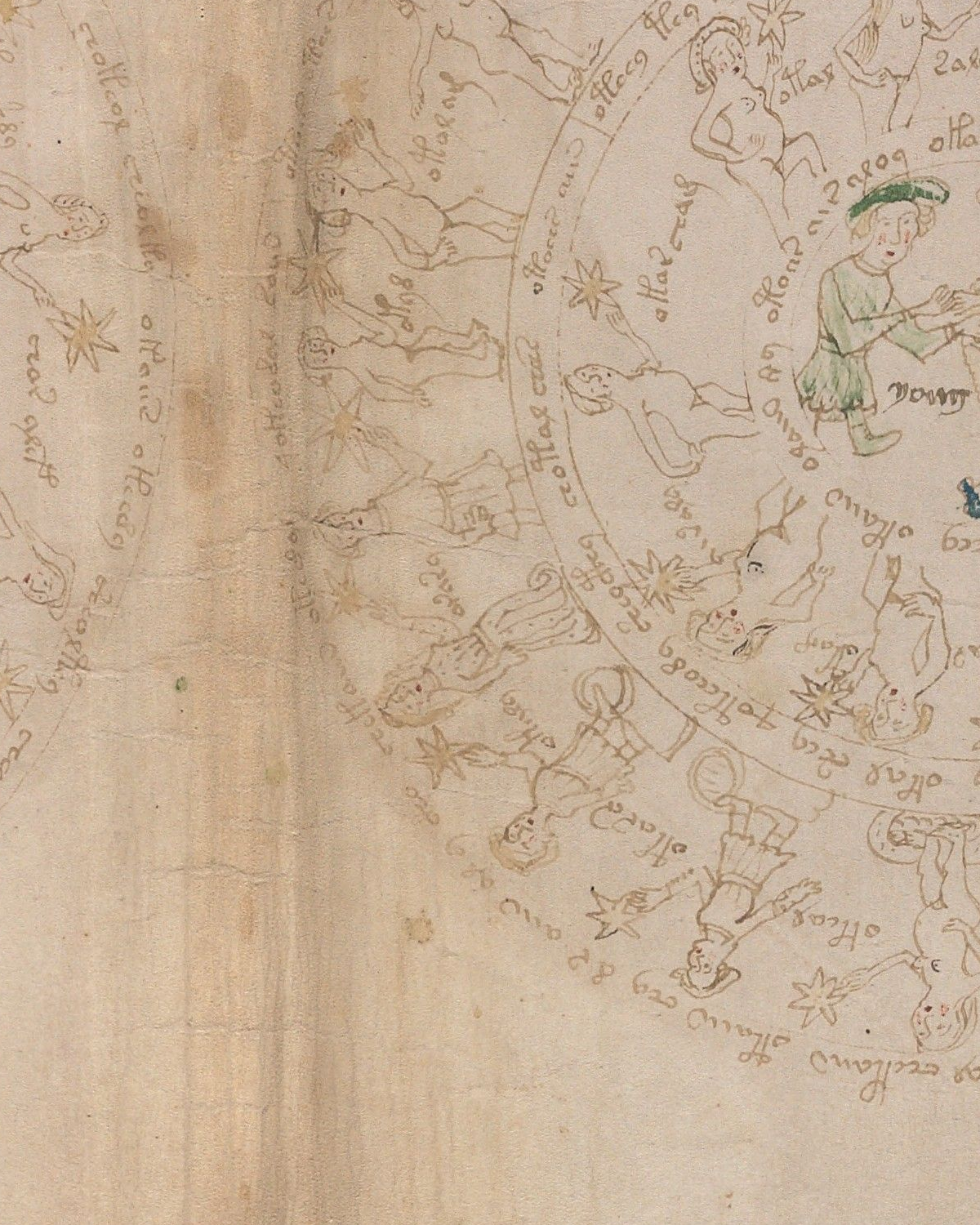
Gemini: western figures with labels — longer words where the Sun's course is longer
- Zodiac labels: 299, one per figure, one per degree of the Sun's path. Their lettering measures the day.
- Container labels: 40 on the container pages, 33 of the 36 fully read standing nowhere else in the book. A word that appears once, beside one drawn thing, is a name.
- Star-chart names: 29 on f68r1, 24 on f68r2, 12 on f68r3. Seventeen of f68r1's share a cell with a naked-eye star Prague sees — okear 50 with Capella, ytchody 100 with Pollux, otykchs 101 with Betelgeuse.
- Paragraph markers: the tall p and f glyphs stand on paragraph first lines — 84.0 % of every p in the book, 79.7 % of every f, 90 of 96 on the container pages. They mark where a record begins, in three sizes.
8Words under concatenation
A word is (k, s, b): its length, its letter sum, its positional sum. Joining two words multiplies: (k, s, b)·(k′, s′, b′) = (k + k′, s + s′, b + b′ + k·s′) — the Heisenberg group over the field. A name written twice is a square, not a doubling; order matters by the commutator k·s′ − k′·s. This is why the mirror changes the φ part and nothing else, and why the mirror alone puts 913 and 203 in sequence.
9How to decipher it: the recipe
Paper III laid down four steps for Rongorongo. They are the steps for the Voynich Manuscript, and this is how far each has gone.
| Step | For Rongorongo | For the Voynich Manuscript | State |
|---|---|---|---|
| 1. Per-line sequences | Barthel numbers per line | EVA per line, mirrored: 5,385 lines, 322 entries with their φ parts | done |
| 2. Repeat-interval search | a glyph every ~584 positions is Venus, ~399 Jupiter, ~116 Mercury | the sky table is built for every degree of 1400–1440; the search over the entries has not been run | next |
| 3. Read the flanking markers as the bearing | anga / ake / iho | the gallows p and f as the paragraph's opening; the barrel, the string, the crown as the figure's marks | partly |
| 4. Back-compute the sky | the epoch when every planet-bearing pair was true | the starless figures and f103r's red stars give 1408 and 1427; the eclipses land on the marked stars | twice, independently |
Step 2 is what remains, and it is arithmetic on tables already saved: for every word, the interval at which it recurs through the 322 entries read backwards, against the synodic periods of Venus 584, Mars 780, Jupiter 399, Saturn 378, Mercury 116 days — and the Moon's 29.53. A word that recurs on a planet's period names the planet. Then its neighbours are what the planet was doing.
The test is the one Paper III set: a genuine record dates itself to one epoch when all of its recovered pairs are true at once. Two independent tests already put the Voynich Manuscript at 1408 and 1427. Step 2 either lands on the same years or it does not.
Paper III §5.6–5.8
10The key-like columns
Seven sides carry a column or a ring of single glyphs. On f49v the column runs one glyph to a line, and the reading takes its letters at their letter values and the three glyphs outside the letters at the transliteration's own numbers.
| Part | Sum | Cell | On the tablet |
|---|---|---|---|
| f o r y e | 69 | 69 | the letters in their order: for ye |
| @140 | 140 | 140 | ATTENUATION |
| k s p o @192 y e | 283 | 26 | GOD; its letters k s p o e are those of SPOKE |
| @164 p o | 195 | 195 | FUNDAMENTAL THEOREM; its fold is 62 |
| @192 | 192 | 192 | PERMISSIONLESS |
| @164 | 164 | 164 | PNEUMATOLOGY |
| @192 y e @140 | 362 | 105 | DIFFRACTION, SUNRISE, EQUINOX |
| the last nine glyphs | 432 | 175 | CONSCIOUSNESS, HOLY TRINITY |
- 140 × 192 × 164 = 4,408,320 = 17,152 × 257 + 256: the three codes multiply to −1. Their sum is 496.
- o r y e is 63; the reflection of 63 is 164, and of 164 is 192.
- o r y e @140 is 203; o @192 y e @140 is 377 ≡ 120, and 377 is F(14).
- The column sums to 1259 ≡ 231 and multiplies to 39; 69 × 26 × 195 × 175 ≡ 23.
- By its own numerals the column reads f 1 2 3 4 5 k s p 1 2 3 4 5 @164 p 1 2 3 4 5 d 3 4 k 3; the numerals sum to 55.
The same rule on the others: f57v's ring, four rounds of seventeen, gives 901, 895, 905, 905, in all 3606 ≡ 8; f76r's column 134; f75v's 95; f66r's column of 34 glyphs 1032 ≡ 4, whose reflection is 140, and its fifteen words 876 ≡ 105. 105 × 164 ≡ 1, and 170 × 171 × 172 ≡ 105.
The reflection has two orbits. On the orbit of 63, with the pole, stand 26, 42, 69, 105, 120, 140, 164, 192, 195, 203, 231, 255; on the other stand 128, 175, 184: the column's last part, the last page's line oror sheey, and f79v.