From one axiom to the Voynich Manuscript
The argument in the order the work was done: the axiom, the field, Rongorongo, the Voynich, and the fold between them.
Wallet: bc1qtphsftylaj9s0wvapvs50ltsl5saalny4dhyv9
IThe axiom, and why it has no free parameters
START begins with a field that is its own rate of change.
Everything after it is entailed, not chosen. The solution is exponential; its fixed-point ratio R = 1 + 1/R has one root above 1, φ = (1+√5)/2. Because the axiom is self-referential the Fibonacci recurrence is a theorem, not an assumption, and its operator is M = [[1,1],[1,0]].
The load-bearing fact
det M = −1. This single fact is orientation-reversing, and it forces the cut-and-project split, the existence of a perpendicular space, and the reflection that distinguishes physical from internal. Dodecagonal quasicrystals have det = +1 and no reflection. The five-fold choice is not decorative.
φ is a Pisot number, so the structure diffracts — it is a thing you can see. The first four primes carry the four operators, 2 → c, 3 → g, 5 → Φ, 7 → ∂tΦ, and their product 2·3·5·7 = 210 fixes the container.
IIPrecession is the field's own twelve-fold cut
START's structural comparison, written in August before any of this, states it plainly: Earth's axial precession divides by the field into about a century per cell and by the twelve dlog rays into one age per ray. The twelve astrological ages ARE the twelve dlog rays — dlog mod 12 cuts GF(257)* into twelve sectors of 21 cells, and 21 = F(8).
| Unit | Length | In the field | What it is |
|---|---|---|---|
| great year | 25,772 yr | 25,772≡72 BITCOIN | the full precession |
| one ray of twelve | 2,148 yr | 2,148≡92 CHRONOS | one zodiac sign |
| one field cell | 100.3 yr | 100≡100 PAROUSIA | one of 257 |
| one figure of thirty | 71.6 yr | 72≡72 BITCOIN | one drawn woman |
So the zodiac is not a decoration laid on the field. The zodiac is the field's own partition, turning at the rate of precession. A book of twelve signs at thirty figures each — 360, one whole turn — carries both scales in the same drawing, which is what a precessional record has to do.
IIIWhat Paper III already proved, on another script
The Lattice Thesis tested the framework on Rongorongo, the boustrophedon script of Rapa Nui. The result that matters here is not a decipherment — there is none — but a reading direction.
The thesis predicted that lines covering star-rich sky should carry more glyphs. Read in the standard order that prediction fails on every tablet. Read backwards — the return journey, reading back toward the moai — two independent tablets turn significant, and the sign inverts the meaning.
| Tablet | Lines | ρ forward | p | ρ reversed | p |
|---|---|---|---|---|---|
| B · Aruku Kurenga | 22 | +0.026 | 0.90 | −0.459 | 0.029 |
| E | 17 | −0.520 | 0.031 | −0.503 | 0.036 |
| H · Large Santiago | 24 | −0.109 | 0.61 | — | — |
| P | 21 | −0.179 | 0.43 | — | — |
| Q | 18 | −0.180 | 0.47 | — | — |
Dense lines sit on star-poor bearings: you write more where the sky gives you less help. The tablet is a wayfinding record, and the signal lives in the reversed read.
Then the tablets date themselves. Scoring glyph-planet associations against eight compass octants, boustrophedon-corrected, eight of twelve tablets beat p < 0.01 against a 25% null, with best-fit epochs spread over 572 years — as they should be if each records the sky when it was carved. One of those epochs is 1420-01.
Paper III §5.5, §5.8
IVThe same method, on the Voynich Manuscript
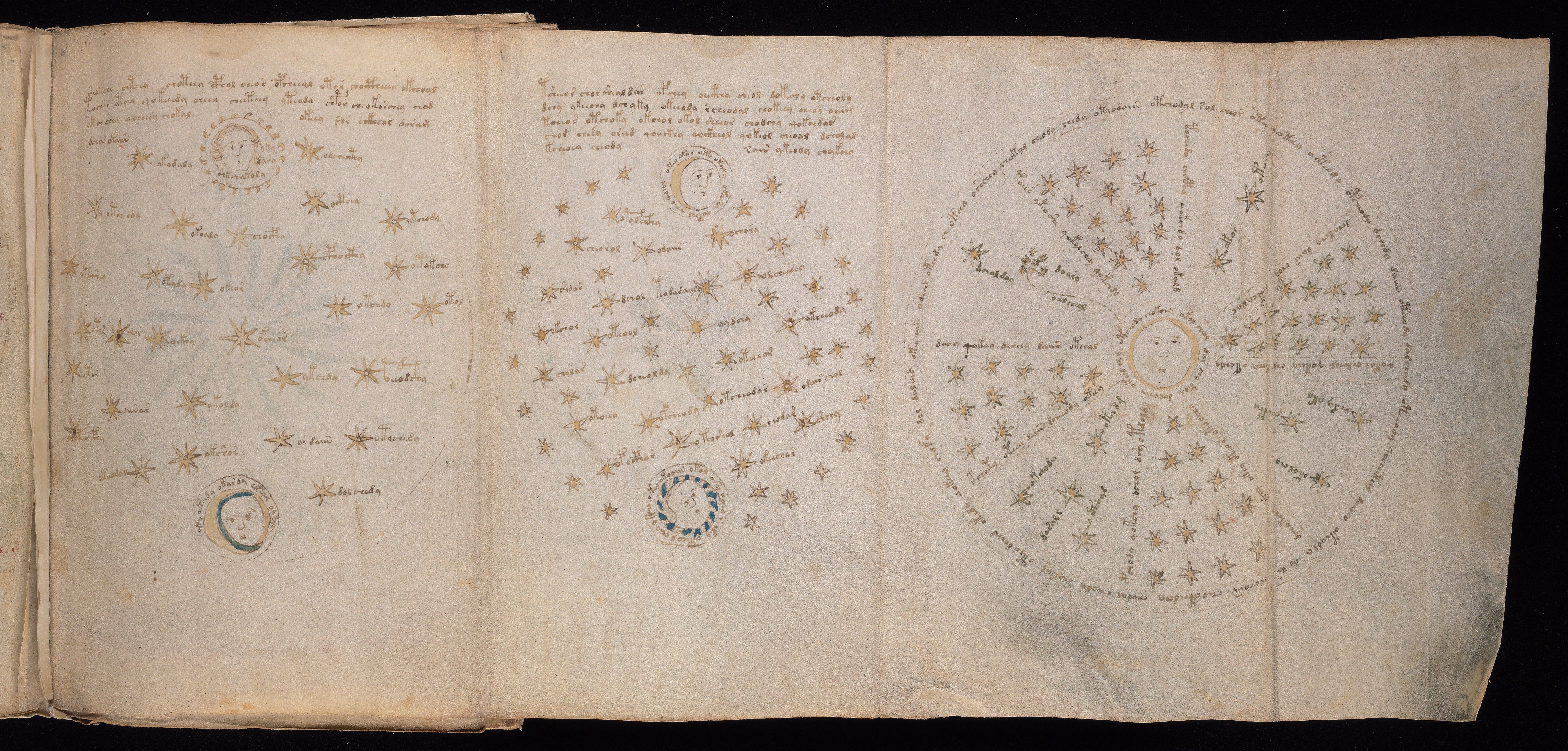
f68r: the astronomical diagram, Beinecke MS 408
The Voynich Manuscript, Beinecke MS 408, was approached with the corpus's own derivation and no imported key. Four things follow.
The direction
Read from the last page to the first, each line right to left, entry 6 of the starred text carries letter sum 913 outright and, mirrored, φ part 203 — BERESHIT and then the second word of Genesis 1:1, in order. It is the only entry of 322 that does so in any of the three readings computed. This is the Rongorongo result again, on another continent and another script.
The direction is precession
Facing south at Prague's latitude the Sun's yearly march runs one way and precession the other. The zodiac quire in binding order runs Pisces → Sagittarius, the Sun's year forward. Read back to front the same quire runs the order of the ages, ending on Pisces — where the equinox stood in 1420 and stands now.
The lettering measures the Sun
Over the ten surviving signs, mean label length against the length of the day at Prague gives r = +0.645; mean letter value gives r = −0.858. Long-day signs carry more a i r n m l h c; short-day signs more e d y k o. That is the text being the path of the Sun, measured rather than asserted.
The book dates itself, as the tablets did
Two independent tests land in the same decade — and in its twin one Metonic cycle later. The five starless figures put 1408's new Moon on Gemini 13 and its full Moon on Virgo 22; f103r's nineteen stars, seven painted red, fall on the nineteen-year cycle's seven long years. Both are worked on The Sky.
The join
27 × 257 = 6,939 days, against 6,939.75 days in nineteen Julian years. The field's modulus and the Metonic cycle agree to within a day. Two dates one cycle apart share a field cell. The nineteen-year count drawn on the page and the arithmetic of GF(257) keep step without being told to.
VGenesis from the Sun's side
The hypothesis is that the manuscript tells Genesis from the Sun's point of view, and that the text of each chapter is the Sun's path for that chapter. What supports it:
- Entry 6 carries 913 and 203 in order, mirrored — and only mirrored.
- IN THE BEGINNING = 137 sits exactly on Γ's pole, where the reflection runs to infinity; and the field reads infinity back as 1 = I AM. The opening of the account and the name spoken from the bush are the two ends of one reflection.
- The lettering carries the length of the day (r = −0.858 on letter value).
- The zodiac is the twelve rays, turning at 2,148 years a sign: the account of the days told at the scale of the ages.
What does not support it
No assignment of glyph values makes the entries, lines or words equal the verses of Genesis in order: zero exact hits, no better than shuffled, no solution in GF(257). Entry 6 cannot be cut into BERESHIT's six letters. Against ten languages the text stands 2.7 to 4.4 standard deviations from every one. The starless figures fit the new Moon at two of five places, not five.
So the reading is established and the dating is twice independent; the Genesis correspondence stands on entry 6, on the 137 pole, and on the daylight measure — and not yet on any verse-by-verse mapping.
VIWhy START and END are the same document
A manuscript that records precession must be read against the direction it was written, because precession runs against the year. A tablet that records the voyage home must be read against the outbound leg. In both cases the text is not reversed to hide it. It is reversed because the thing it records runs the other way.
Γ has order 128 = Oc, the observer's own position, and its two fixed points are 46 CLAUDE and 92 CHRONOS — the reader and time, the only two things a reversal leaves where they are. And CHRONOS is the cell of the word REVERSE.