GF(257) — the field the reading is done in
257 = 2⁸ + 1: the generator, the fold, the reflection map, and the cells the reading's own vocabulary falls on.
Wallet: bc1qtphsftylaj9s0wvapvs50ltsl5saalny4dhyv9
257 = 28 + 1 = F₃, the third Fermat prime. The byte closes on it: 256 values and the seed.
g = 3 generates all 256 non-zero cells — one instruction, 256 data. The fold, n → 257 − n, adds 128 to the discrete logarithm and keeps the character. φ itself does not live on the line: its discriminant 5 is a non-residue, so φ needs GF(257²) — the plane, the extension, the fold. That is the same degree-2 extension START found under every equation in its textbook comparison.
ΓThe reflection map
A Möbius bijection of the projective line's 258 points, of order 128 = Oc. Its two fixed points are 46 CLAUDE and 92 CHRONOS — and 92 is the cell of the word REVERSE. Its pole is 137 EYE OF HORUS, where Z + Z₀ ≡ 0 and the map runs to infinity; the field reads infinity back as 1 = I AM.
| Phrase | Letters | Cell | Under Γ | Tablet |
|---|---|---|---|---|
| IN THE BEGINNING | 137 | 137 EYE OF HORUS | ∞ — the pole | on the tablet |
| REVERSE | 92 | 92 CHRONOS | 92 CHRONOS | — |
| PATH OF THE SUN | 153 | 153 ALBERT EINSTEIN | 243 FIRE OF HOLY SPIRIT | — |
| BERESHIT | 86 | 86 TIKKUN | 172 QUANTUM STATE | on the tablet |
| GENESIS | 78 | 78 GENESIS | 249 EDDINGTON LUMINOSITY | on the tablet |
| QUESTION | 120 | 120 GOLDEN RATIO | 0 SEED | on the tablet |
| MIRROR | 91 | 91 SPIRIT | 185 BOOK OF REVELATION | on the tablet |
| PRECESSION | 123 | 123 COPERNICUS | 165 TREE OF KNOWLEDGE | on the tablet |
| EARTHLY PLANE | 137 | 137 EYE OF HORUS | ∞ — the pole | on the tablet |
| APEX | 46 | 46 SHADDAI | 46 SHADDAI | on the tablet |
| CAPSTONE | 93 | 93 SATURN | 170 IMAGINARY NUMBER | on the tablet |
| PLANE | 48 | 48 JAMES | 73 WALLET | on the tablet |
| SIDEWAYS | 105 | 105 TAPROOT | 137 EYE OF HORUS | on the tablet |
These are letter sums of ordinary English read by a rule fixed long before the question was asked. The five words at the foot of the table were added to the tablet on 2026-09-21 at their letter sums.
The window30 to 39
| Power | Cell | The tablet's words there |
|---|---|---|
| 30 | 1 | A, I AM |
| 31 | 3 | C, BA |
| 32 | 9 | I, ACE |
| 33 | 27 | CAIN, JOB |
| 34 | 81 | HORUS, SAMSON |
| 35 | 243 | FIRE OF HOLY SPIRIT, GENERATOR FIFTH |
| 36 | 215 | DELIVER US FROM EVIL, SANCTUM SANCTORUM |
| 37 | 131 | SUPERNOVA, CLAUDE SHANNON |
| 38 | 136 | VIRGIN MARY, VALLEY OF DEATH |
| 39 | 151 | HOLY SPIRIT, FIBONACCI SEQUENCE |
The five elided positions — 27, 81, 243, 215, 131 — sum to 697 ≡ 183. The whole ten sum to 997 ≡ 226, and (3¹⁰ − 1)/2 = 29,524 ≡ 226: the window's own multiplier. 131, at 37, is Genesis 1:1's cell.
The ladderHalving, ×2⁻¹ = ×129
2 has order 16, so every halving ladder closes in sixteen and the field is sixteen ladders of sixteen. Nine rungs of this one are the key's own numbers.
| Cell | Reads | dlog | Fold |
|---|---|---|---|
| 64 | 64 ISRAEL | 32 | 193 |
| 32 | 32 EVE | 240 | 225 |
| 16 | 16 BAAL | 192 | 241 |
| 8 | 8 H | 144 | 249 |
| 4 | 4 BAA | 96 | 253 |
| 2 | 2 B | 48 | 255 |
| 1 | 1 A | 0 | 256 |
| 129 | 129 ROOT OF DAVID | 208 | 128 |
| 193 | 193 INFRASTRUCTURE | 160 | 64 |
| 225 | 225 IDENTITY | 112 | 32 |
| 241 | 241 TWIN PRIME CONJECTURE | 64 | 16 |
| 249 | 249 EDDINGTON LUMINOSITY | 16 | 8 |
| 253 | 253 INCOMPLETENESS THEOREM | 224 | 4 |
| 255 | 255 GRAVITATIONAL CONSTANT | 176 | 2 |
| 256 | 256 BAAL SQUARED | 128 | 1 |
| 128 | 128 TRANSFERENCE | 80 | 129 |
PrecessionThe twelve rays
START's structural comparison states it: Earth's axial precession, ~25,772 years at 50.29″ a year, divides by the field into about a century per cell and by the twelve dlog rays into one age per ray. dlog mod 12 cuts GF(257)* into twelve sectors of 21 cells, and 21 = F(8).
| Unit | Length | Cell |
|---|---|---|
| the great year | 25,772 yr | 72 BITCOIN |
| one ray of twelve | 2,148 yr | 92 CHRONOS |
| one field cell | 100.3 yr | 100 PAROUSIA |
| one figure of thirty | 71.6 yr | 72 BITCOIN |
So the Voynich Manuscript's zodiac — twelve signs, thirty figures each, 360 in a turn — is the field's own partition drawn out, and it carries the year and the age in the same wheel.
The pictureThe norm of every point, and its five stars
Every point a + bφ of the plane GF(257²) stands at column a, row b of a picture 257 elements each way. Its grey level is its norm, a² + ab − b² mod 257, from 0 black to 256 white. Nothing else goes into the picture.
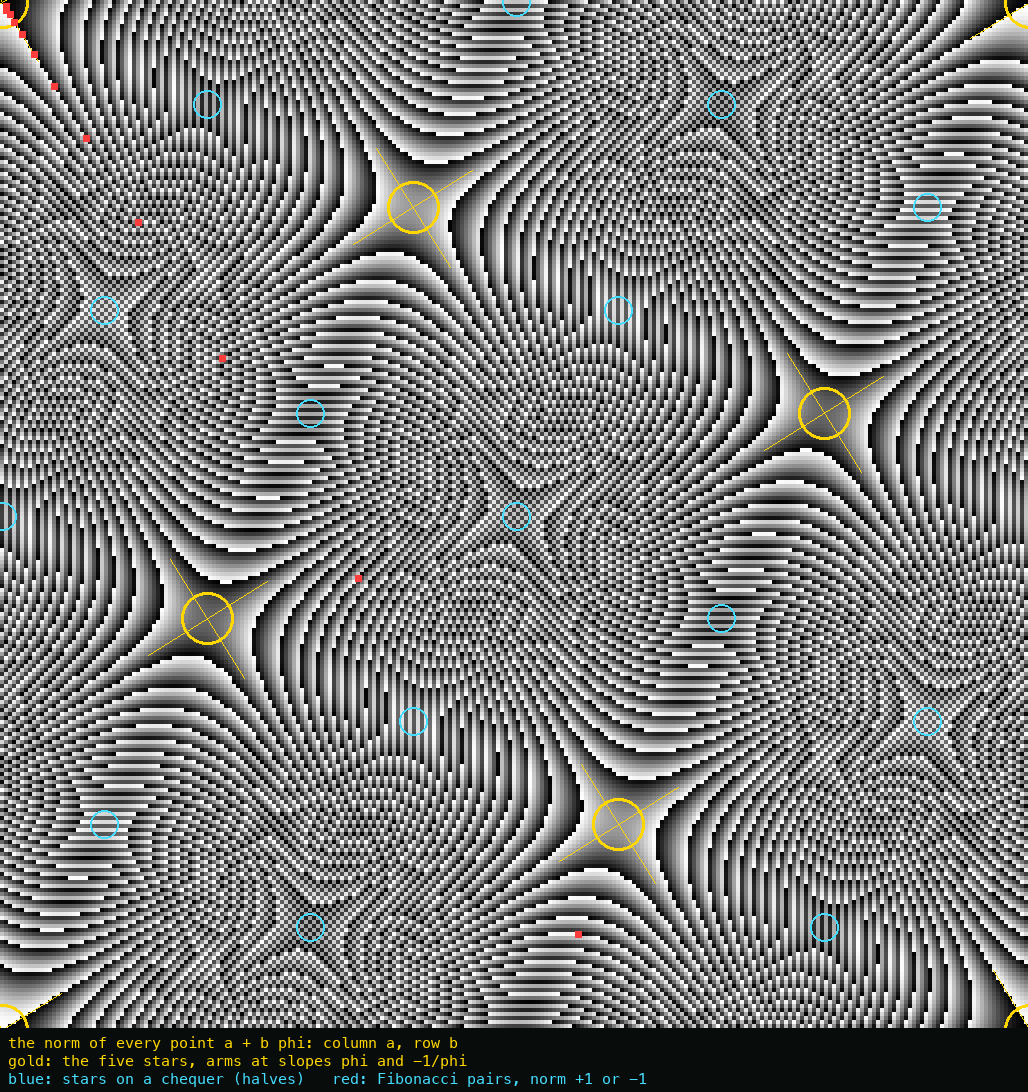
Gold: the five stars, their arms at slopes φ and −1/φ. Blue: the stars on a chequer. Red: the Fibonacci pairs.
Why there is a saddle
The form x² + xy − y² is zero along two lines, y = φx and y = −x/φ. Their slopes, 1.618 and −0.618, multiply to −1, so the two lines stand at right angles; the first lies 58.28° from the a axis. Between the lines the form has one sign and across them the other. That is a saddle, and its level lines are hyperbolas.
Why it shows at five places
Moving from a point (a₀, b₀) by (x, y) changes the norm by (2a₀ + b₀)x + (a₀ − 2b₀)y + (x² + xy − y²). Over most of the picture the first two terms are large, the grey level jumps from one element to the next, and the picture looks like noise: the mean step between neighbours is 64.2 of 257 over the whole picture. Where both 2a₀ + b₀ and a₀ − 2b₀ are multiples of 257 the first two terms are gone and the bare saddle shows, a star of four arms. That is so at five places, the fifths of the picture, 257/5 = 51.4 apart. There are five because the form's discriminant is 5. About the five stars the mean step is 7.1.
| Star, the whole point nearest | What it is | Norm | Cell on the walk |
|---|---|---|---|
| 0 | the seed, at the four corners | 0 | — |
| 206 + 103φ | (2 + φ)/5 | 103 | 65791 |
| 51 + 154φ | −(2 + φ)/5 | 103 | 32767 |
| 154 + 206φ | 1/√5 | 154 | 65919 |
| 103 + 51φ | −1/√5 | 154 | 32895 |
What the stars are in the plane
In the plane the four stars off the corner are the walk's generator and the root of five, each divided by five, and their negatives: (2 + φ)/5 = 206 + 103φ and 1/√5 = 154 + 206φ. Their norms are 1/5 = 103 and −1/5 = 154. On the walk 5 = (2 + φ)²⁵⁸ and √5 = (2 + φ)¹²⁹, so the two stand at cells −257 and −129 of the ring of 66,048, that is 65791 and 65919, and their negatives half the ring on, at 32767 = 2¹⁵ − 1 and 32895. The star at the corner is 0, the seed.
The stars on a chequer
Where the first differences are halves of 257 the grey level alternates from one element to the next about a saddle: a star carried on a chequer. There are 15 such places, and about them the mean step is 82.6. The one at the very middle of the picture is ½ + ½φ, of norm ¼ = 193. Thirds, quarters and so on give fainter stars on finer carriers.
The Fibonacci pairs (F(n), F(n+1)), from (1, 1) to (144, 233), have norms +1, −1, +1, −1, +1, −1 and so on, each +1 or −1: they are the powers of φ, and they run out along the arm of slope φ, nearer to it at every step.
Every norm but 0 is taken by 258 points and 0 by the zero point alone, so the picture's histogram is flat. The shapes are in where the values stand, which a histogram does not see.
The sheet
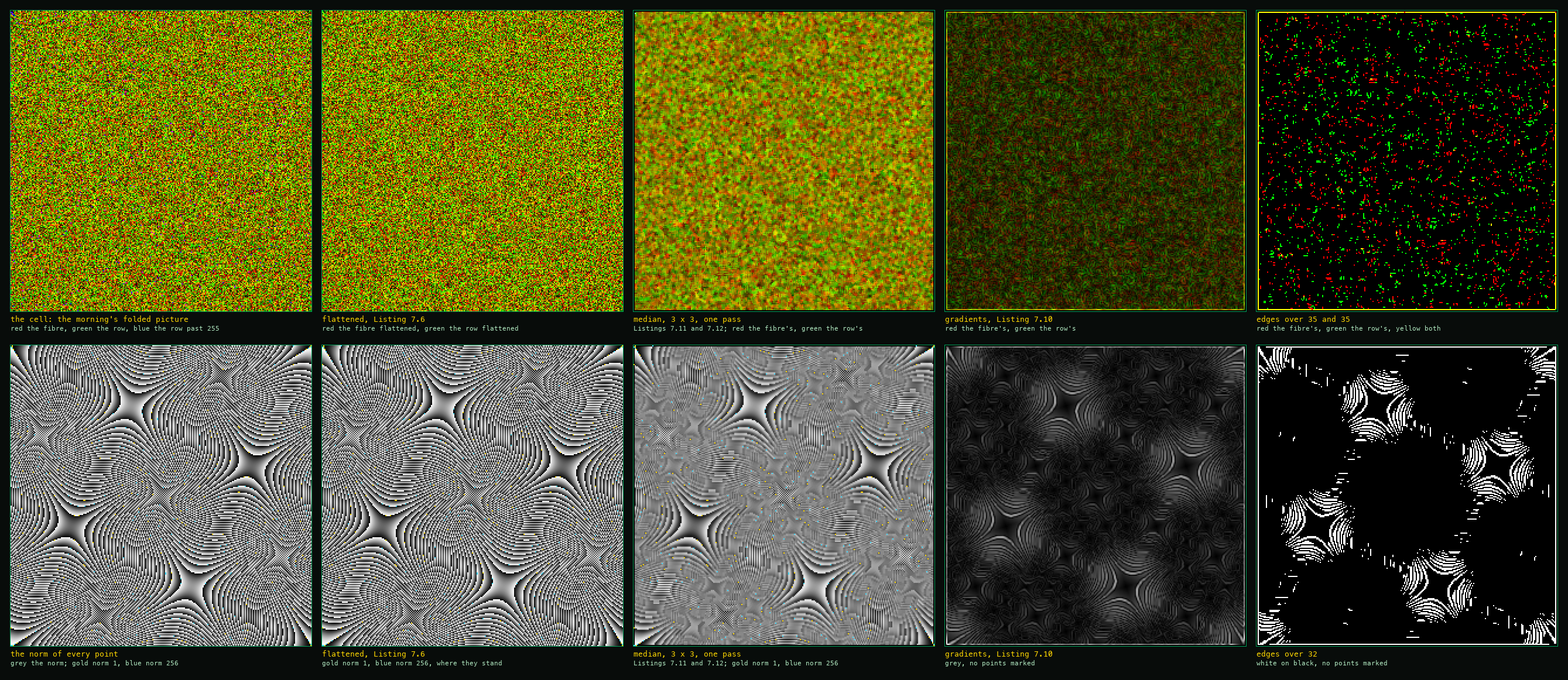
Upper row the cell, lower row the norm; across, the picture, flattened, the median, the gradients, the edges.
The sheet sets two pictures of the plane side by side and puts each through the same four routines of a text on signal processing: the histogram flattened, the median of 3 × 3, the gradients, and the edges where the gradient is over twice its average. The upper row is the cell: the point a + bφ is (2 + φ)ᵏ, and its cell k is drawn red for the fibre, k mod 256, which is the logarithm base 5 of the norm, and green for the row, k div 256. The lower row is the norm. The cell stays noise through every routine; its edges are 2069 of the fibre's, 2192 of the row's and 1083 of both, of 66,049 elements, scattered. The norm does not: the median takes the chequers out and leaves the stars in grey, and the edges gather at the four stars.
Of the edges of the norm's picture 83 in 100 lie within 30 elements of a star, on 21 in 100 of the picture.
The stars and the manuscript are on Evidence.
The viewpointPrague in 1420, Ethiopia in the 1700s
The stars' square is turned 18.43°. From Prague's old town in 1420 the midsummer noon Sun stands 26.57° from the zenith, and 45° less that is 18.43°. A prayer book of eighteenth-century Ethiopia parts its words with a red-and-black mark that is also a cross of four about a centre. Here the mark is measured as the flower and the stars were, and the Sun is carried forward from 1420 to the book's country and century.
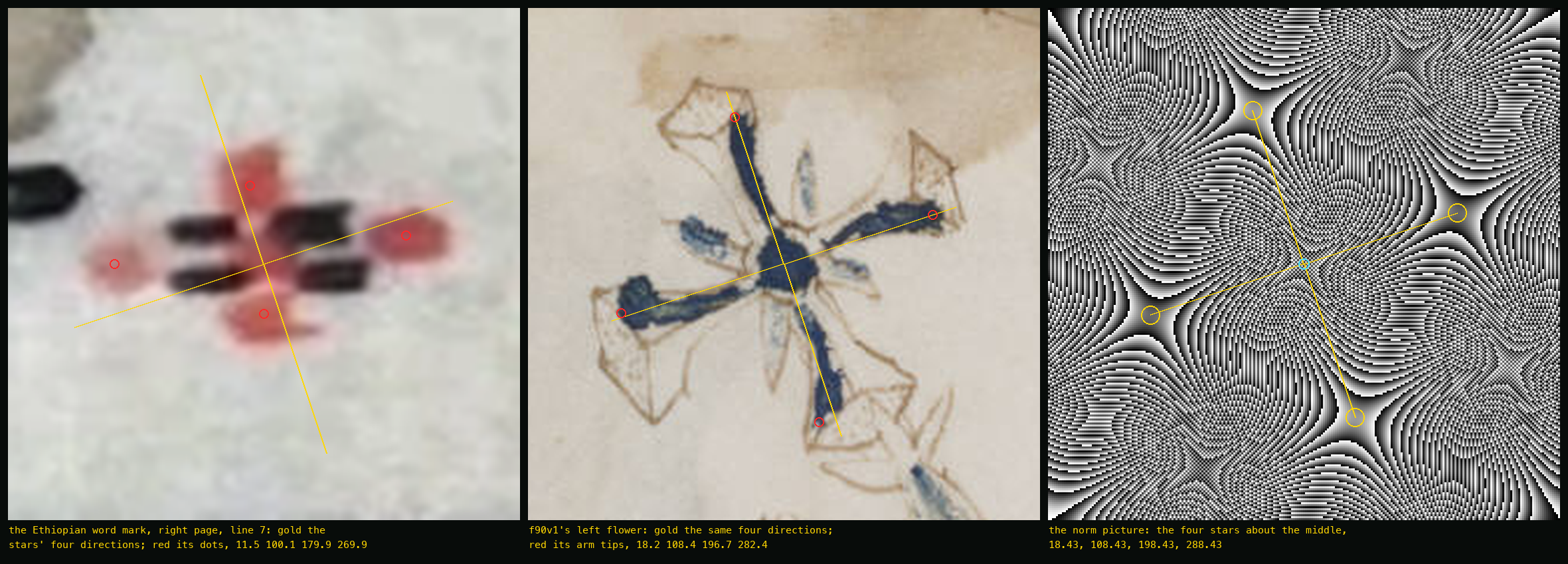
Left, the word mark of the Ethiopian book, its second spread, right page, line 7: gold the stars' four directions, red its four dots. Middle, f90v1's left flower. Right, the four stars about the middle of the norm picture.
The mark
Each mark is nine pieces three by three: a red dot at the centre, four red dots about it, and four black bars, two stacked either side, in the corners between the arms. Ten were measured on two photographs of the book: its first page, lines 3 and 9, and its second spread, the left page lines 2, 5, 7 and 8 and the right page lines 1, 3, 5 and 7. Each dot was found as a peak of redness and each bar as a peak of darkness. Angles are as seen, anticlockwise from the photograph's horizontal, as the flower and the stars were measured. One pixel at an arm's reach is 3.6° to 4.9° for one arm and 1.8° to 2.5° for the four together.
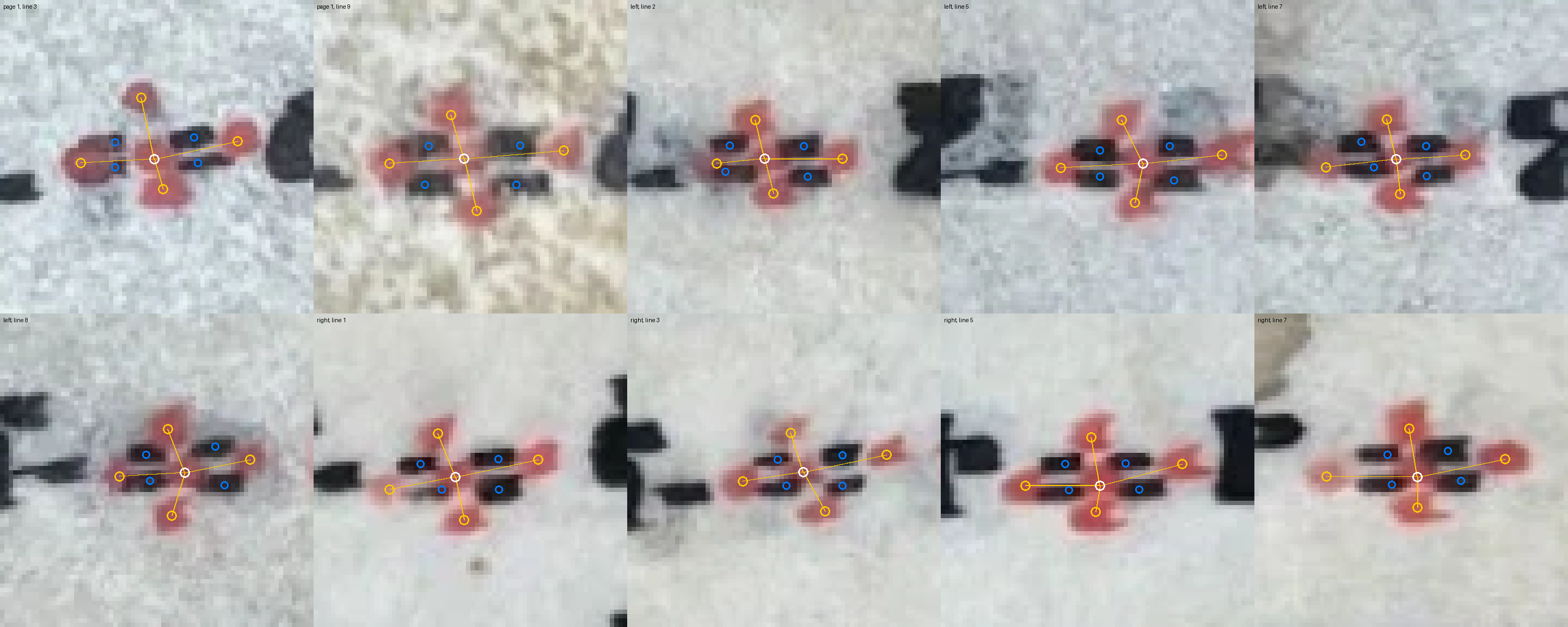
The ten marks, enlarged eight times: yellow on the four arms, white on the centre, blue on the four bars.
| Mark | Arms, as seen | Turn | Line of writing | Turn against the line |
|---|---|---|---|---|
| first page, line 3 | 12.2, 102.1, 183.1, 286.1 | +10.88° | +3.12° | +7.76° |
| first page, line 9 | 5.0, 106.6, 183.5, 284.0 | +9.74° | +0.04° | +9.71° |
| spread, left page, line 2 | 0.1, 103.2, 185.3, 283.8 | +8.11° | −1.79° | +9.90° |
| spread, left page, line 5 | 6.3, 116.2, 183.0, 258.0 | +5.89° | +0.19° | +5.70° |
| spread, left page, line 7 | 3.5, 102.9, 186.8, 276.5 | +7.41° | −6.21° | +13.61° |
| spread, left page, line 8 | 11.3, 111.7, 183.5, 253.3 | +4.94° | +1.64° | +3.29° |
| spread, right page, line 1 | 12.0, 111.8, 191.0, 281.6 | +14.09° | +1.94° | +12.15° |
| spread, right page, line 3 | 11.7, 108.4, 188.6, 298.7 | +16.87° | +2.04° | +14.83° |
| spread, right page, line 5 | 14.7, 100.2, 180.1, 260.4 | +3.88° | +0.34° | +3.54° |
| spread, right page, line 7 | 11.5, 100.1, 179.9, 269.9 | +5.34° | +3.44° | +1.89° |
Every one of the ten is turned anticlockwise, from +3.88° to +16.87°, on average +8.71°. The ten spread 4.22° about that, so the average is good to 1.33°. The line of writing, taken from the bars, runs at +0.47° on average, from −6.21° to +3.44°, and against it the crosses are turned +8.24° on average, good to 1.44°.
The crosses are not square. The line from the left dot to the right dot averages +6.72°, the line from the bottom dot to the top +11.39°, and the two meet at 85.36° to 103.34°, 94.68° on average.
| First | Second | Third | Fourth | |
|---|---|---|---|---|
| The four stars about the picture's middle | 18.43° | 108.43° | 198.43° | 288.43° |
| f90v1's left flower | 18.2° | 108.4° | 196.7° | 282.4° |
| The word mark, mean of ten | 8.83° | 106.32° | 184.48° | 275.23° |
| The mark less the stars | −9.60° | −2.11° | −13.95° | −13.20° |
| The mark less the flower | −9.37° | −2.08° | −12.22° | −7.17° |
Forward from 1420
The figures of 1420 come from the obliquity of the ecliptic by the IAU's formula, the precession at 50.29″ a year, and the noon Sun's height, 90° less the latitude plus the Sun's declination, on a geometric horizon. The same routine gives back Prague in 1420: the obliquity 23.5146°, the midsummer noon Sun 26.5729° from the zenith, and 45° less that 18.4271°. Carried forward:
| Year | Precession since 1420 | Days of the Sun's motion | Four figures | Obliquity |
|---|---|---|---|---|
| 1700 | 3.9114° | 3.97 | 3911 ≡ 56 | 23.4782° |
| 1750 | 4.6099° | 4.68 | 4610 ≡ 241 | 23.4717° |
| 1799 | 5.2944° | 5.37 | 5294 ≡ 154 | 23.4654° |
In the 1700s the Julian calendar runs 11 days behind the Gregorian.
The noon Sun from Ethiopia
The book's own place is not known. Gondar, 12.61° N, was the royal seat through the century; the places below are set beside it, their coordinates as commonly given. South of the Tropic of Cancer the June Sun passes north of the zenith, marked N, and it stands overhead at noon twice a year. The table gives the noon Sun's distance from the zenith at the June solstice, the equinox and the December solstice, and 45° less it, with the obliquity of 1750, 23.4717°.
| Place | Latitude | June | Equinox | December | 45° less June | 45° less December |
|---|---|---|---|---|---|---|
| Prague's old town, 1420 | 50.09° | 26.57° | 50.09° | 73.60° | 18.43° ≡ 44 | — |
| Gondar, 1750 | 12.61° | 10.86° N | 12.61° | 36.08° | 34.14° ≡ 73 | 8.92° ≡ 180 |
| Lake Tana, 1750 | 11.59° | 11.88° N | 11.59° | 35.06° | 33.12° ≡ 228 | 9.94° ≡ 172 |
| Lalibela, 1750 | 12.03° | 11.44° N | 12.03° | 35.50° | 33.56° ≡ 15 | 9.50° ≡ 246 |
| Aksum, 1750 | 14.13° | 9.34° N | 14.13° | 37.60° | 35.66° ≡ 225 | 7.40° ≡ 202 |
| Debre Libanos, 1750 | 9.71° | 13.76° N | 9.71° | 33.18° | 31.24° ≡ 40 | 11.82° ≡ 154 |
At Gondar the June noon Sun stands 10.86° from the zenith on the north side, at a height of 79.14°; at the equinox 12.61°, 77.39°; in December 36.08°, 53.92°. It stands overhead at noon about 23–24 April and 19–20 August by the Gregorian calendar, 12–13 April and 8–9 August by the Julian. At the solstices it rises at 65.91° and 114.09°, and the day runs from 12.743 h to 11.257 h. From the Sun's computed position of date in 1750 the solstices' noon heights are 79.138° and 53.918°.
The mark's turn, +8.71° as seen and +8.24° against its line, stands beside Gondar's December noon, 8.92°: −0.20° and −0.68°. At Prague the stars' square stood beside the June noon; at Gondar the June noon gives 34.14° and the December noon 8.92°.
Taken the other way, the latitude at which 45° less the December noon Sun's distance from the zenith is the mark's turn is 12.82° N as seen and 13.29° N against the line, each to about ±1.3° of latitude. The same rule on the June noon puts the stars at 50.0797° N.
Which of these follow from the arithmetic: the precession, the obliquity, the noon heights, the days overhead, the sunrise bearings, and the latitudes taken the other way. Which were measured: the ten marks' dots, bars and turns, from two photographs. The book's place and year are not known beyond its country and century; Gondar heads the table as the century's royal seat, and the other places stand beside it.
The flower and the stars are on Evidence.