The Voynich Manuscript dates itself, twice
910 eclipses of 1301–1500, what Prague saw of each, the Moon in the Pleiades, and the two independent tests that land on 1408 and 1427.
Wallet: bc1qtphsftylaj9s0wvapvs50ltsl5saalny4dhyv9
The Voynich Manuscript is dated from the sky it records, not from a date brought to it. Two tests were run separately and land in the same decade — and in its twin one Metonic cycle later.
source NASA Five Millennium Catalog of Solar and Lunar Eclipses, eclipse.gsfc.nasa.gov, pages SE/LE 1301–1400 and 1401–1500, read 2026-09-21, counts checked against the pages' own totals.
what Prague saw prague_view.json — Sun and Moon from astropy, parallax by hand, stepped every minute over ±3.5 h of greatest eclipse.
Test 1The five starless figures and the Moon

The five figures holding no star, matched to the Moon
Of 299 figures exactly five hold no star. Taking each figure as one degree of the Sun's path, in list order, the Moon's age on each of those five days was computed for every year from 1301 to 1500.
| Year | Figure | Date (Julian) | Moon's age | Phase |
|---|---|---|---|---|
| 1408 | Gem 13 | 05-25 | 360° | new Moon |
| 1408 | Can 10 | 06-22 | 346° | -1 days from new |
| 1408 | Can 18 | 07-01 | 100° | +1 days from first quarter |
| 1408 | Vir 22 | 09-05 | 181° | full Moon |
| 1408 | Sag 18 | 11-30 | 142° | -3 days from full |
| 1427 | Gem 13 | 05-26 | 358° | new Moon |
| 1427 | Can 10 | 06-23 | 344° | -1 days from new |
| 1427 | Can 18 | 07-01 | 93° | first quarter |
| 1427 | Vir 22 | 09-06 | 184° | full Moon |
| 1427 | Sag 18 | 12-01 | 146° | -3 days from full |
1427 repeats 1408 to within 2°, as it must — the two are one nineteen-year cycle apart. Both are the third year of that cycle, one of its long years.
Where it fails
"No star means no Moon" fits Gemini 13 and Cancer 10. The other three fall near first quarter and full Moon. One rule does not yet cover all five.
Test 2f103r's nineteen stars, seven painted red
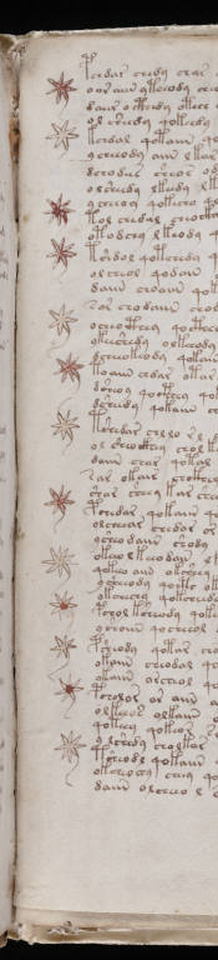
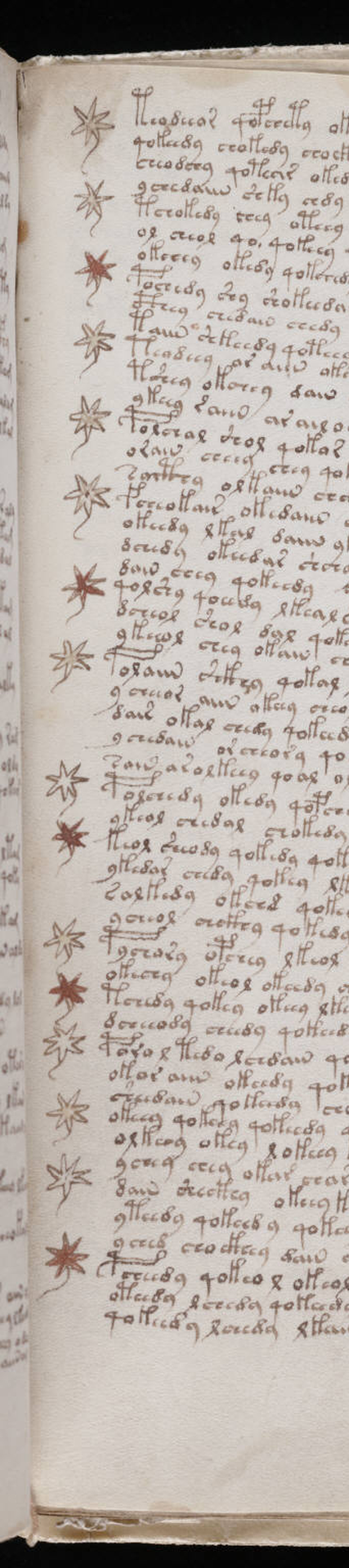
Margin stars from f104r and f108r
The last page of the starred text carries nineteen stars, seven of them painted red, at positions 1, 4, 6, 9, 12, 14, 17 from the top. The nineteen-year cycle has seven long years of thirteen months, at years 3, 6, 8, 11, 14, 17, 19.
Read from the foot upward — the direction the book is read — six of the seven fall on long years as the page stands, and all seven do on one placement. The page image was checked against the transcribers' notes star by star, and f108r's five dark stars check too.
The join
27 × 257 = 6,939 days, against 6,939.75 days in nineteen Julian years and 6,939.69 in 235 lunar months. The field's modulus and the Metonic cycle agree to within a day, so two dates one cycle apart share a field cell. This is why 1408 and 1427 give the same reading, and why 1413-11-08 and 1432-11-07 both land on cell 153.
Test 3The holes as the Sun's image
A round beam falls on a level page as an ellipse, and its short axis over its long is the sine of the Sun's altitude. Read so, each hole with a clean rim is an altitude, and at Prague's noon an altitude is two days of the year. The rule taken is a level page at noon at Prague.
| Hole | Short over long | Altitude | Noon at Prague, 1420 Julian | |
|---|---|---|---|---|
| f28 pointed | 0.421 | 24.9° | ± 1.5° | 31 Jan, Aquarius 20 · 25 Oct, Scorpio 11 |
| f34 | 0.491 | 29.4° | ± 1.4° | 13 Feb, Pisces 3 · 11 Oct, Libra 27 |
| f116 | 0.542 | 32.8° | ± 3.2° | 22 Feb, Pisces 12 · 2 Oct, Libra 18 |
| f41 | 0.633 | 39.3° | ± 3.1° | 10 Mar, Pisces 29 · 15 Sep, Libra 1 |
| f15 | 0.647 | 40.3° | ± 2.9° | 12 Mar, Aries 1 · 13 Sep, Virgo 29 |
| f46 | 0.719 | 46.0° | ± 4.2° | 27 Mar, Aries 15 · 29 Aug, Virgo 14 |
| f37 on the seam | 0.724 | 46.4° | ± 8.8° | 28 Mar, Aries 16 · 28 Aug, Virgo 13 |
| f28 upper of the pair | 0.735 | 47.3° | ± 3.6° | 31 Mar, Aries 19 · 26 Aug, Virgo 12 |
| f28 lower of the pair | 0.768 | 50.2° | ± 1.7° | 7 Apr, Aries 26 · 18 Aug, Virgo 4 |
| f11 | 0.770 | 50.4° | ± 4.0° | 8 Apr, Aries 27 · 17 Aug, Virgo 3 |
| f72 | 0.826 | 55.7° | ± 2.9° | 24 Apr, Taurus 13 · 1 Aug, Leo 17 |
| f82 | 0.887 | 62.5° | ± 10.6° | 27 May, Gemini 14 · 29 Jun, Cancer 16 |
| f107 | 0.891 | 63.0° | ± 6.1° | 2 Jun, Gemini 20 · 23 Jun, Cancer 10 |
- f41 and f15 stand at 39.3° and 40.3°, beside the equinox noon of 39.91°.
- Five of the thirteen stand between 46.0° and 50.4°.
- f82 and f107 stand at the year's ceiling, 63.4°.
- f72's hole is on Taurus's page, and its two days are in Taurus and in Leo.
More than one hole on a skin
f28 carries three holes. The pair read 0.735 and 0.768, altitudes 47.3° and 50.2°; the pointed hole reads 0.421, 24.9°. f11 and f14 are the two halves of one skin: f11 reads 0.770, and f14, its right rim not seen, between 0.62 and 0.78. f36 and f37 are one skin: f37's hole on the seam reads 0.724, and f36's holes are ragged.
All thirteen ratios lie inside the range of Prague's noon through the year, 0.282 to 0.894.
The holes as tilts, by the 210-gon's step
A disc seen at a tilt t shows the ratio cos t. The 210-gon's step is 360/210 = 12/7 of a degree, 1.7143°. Each hole's tilt is given in steps, with the measure's own error in steps.
| Hole | Short over long | Tilt | Steps of the 210-gon | ± |
|---|---|---|---|---|
| f28 pointed | 0.421 | 65.13° | 37.99 | 0.9 |
| f34 | 0.491 | 60.62° | 35.36 | 0.8 |
| f116 | 0.542 | 57.18° | 33.36 | 1.9 |
| f41 | 0.633 | 50.69° | 29.57 | 1.8 |
| f15 | 0.647 | 49.70° | 28.99 | 1.7 |
| f46 | 0.719 | 43.99° | 25.66 | 2.5 |
| f37 on the seam | 0.724 | 43.65° | 25.46 | 5.1 |
| f28 upper of the pair | 0.735 | 42.66° | 24.89 | 2.1 |
| f28 lower of the pair | 0.768 | 39.83° | 23.23 | 1.0 |
| f11 | 0.770 | 39.62° | 23.11 | 2.3 |
| f72 | 0.826 | 34.30° | 20.01 | 1.7 |
| f82 | 0.887 | 27.52° | 16.06 | 6.2 |
| f107 | 0.891 | 26.96° | 15.73 | 3.5 |
The holes as openings for light
The four holes first measured run from 4.8 by 4.2 mm, f82, to 13.9 by 11.5 mm, f72, the leaf's height, 225 mm, taken as 3,700 px. At 480 nm, the book's blue, the first dark ring of such a hole stands 10.5 to 30.2 seconds of arc off the axis, which at a metre is 0.05 to 0.15 mm.
The largestSolar eclipses Prague actually saw, 1301–1500
| Date (Julian) | Type | Magnitude at Prague | Sun's altitude | Saros |
|---|---|---|---|---|
| 1310-01-31 | A | 0.853 | 16.0° | saros 100 |
| 1321-06-26 | H | 0.981 | 20.0° | saros 106 |
| 1330-07-16 | T | 0.982 | 22.9° | saros 125 |
| 1339-07-07 | H | 0.980 | 43.0° | saros 106 |
| 1366-08-07 | H | 0.974 | 3.3° | saros 125 |
| 1386-01-01 | T | 0.903 | 16.7° | saros 102 |
| 1399-10-29 | P | 0.820 | 20.7° | saros 133 |
| 1406-06-16 | T | 0.946 | 27.8° | saros 127 |
| 1409-04-15 | A | 0.893 | 25.9° | saros 119 |
| 1415-06-07 | T | 1.013 total | 28.7° | saros 108 |
| 1424-06-26 | T | 0.955 | 32.2° | saros 127 |
| 1431-02-12 | T | 0.857 | 14.6° | saros 121 |
| 1433-06-17 | T | 0.989 | 31.5° | saros 108 |
| 1446-04-26 | P | 0.860 | 0.0° | saros 129 |
| 1485-03-16 | T | 0.967 | 13.4° | saros 121 |
| 1491-05-08 | A | 0.802 | 40.4° | saros 110 |
Laid on the zodiac figure for each day, three of the largest land on figures with one-of-a-kind marks: 19 October 1408 on Scorpio's figure 5, whose star alone on that page carries a dark blot; 7 June 1415, the total, at Gemini 23.9° — the solid ochre star with no pen outline; 26 June 1424 on Cancer's figure 14, the only half figure on the page.
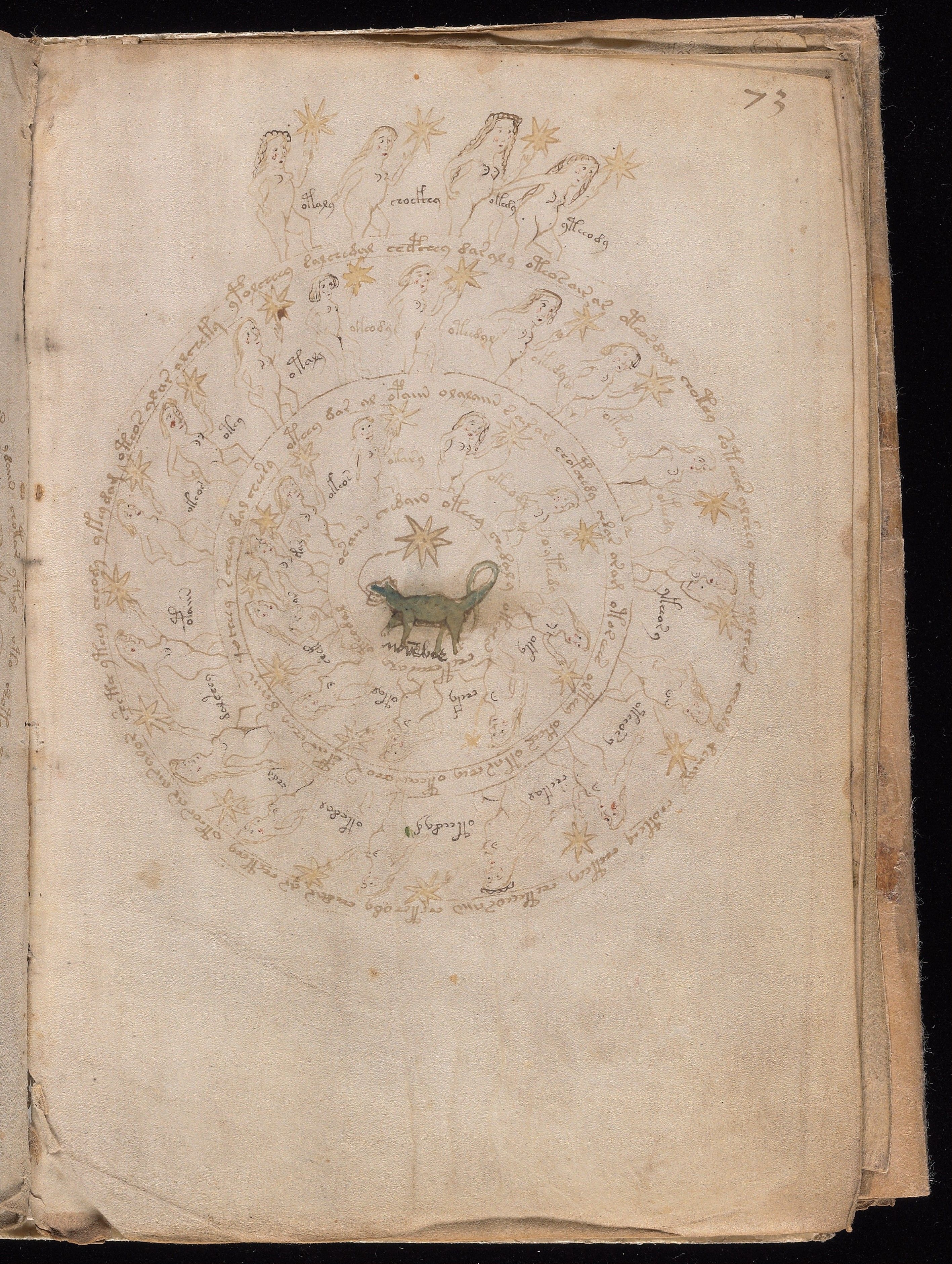
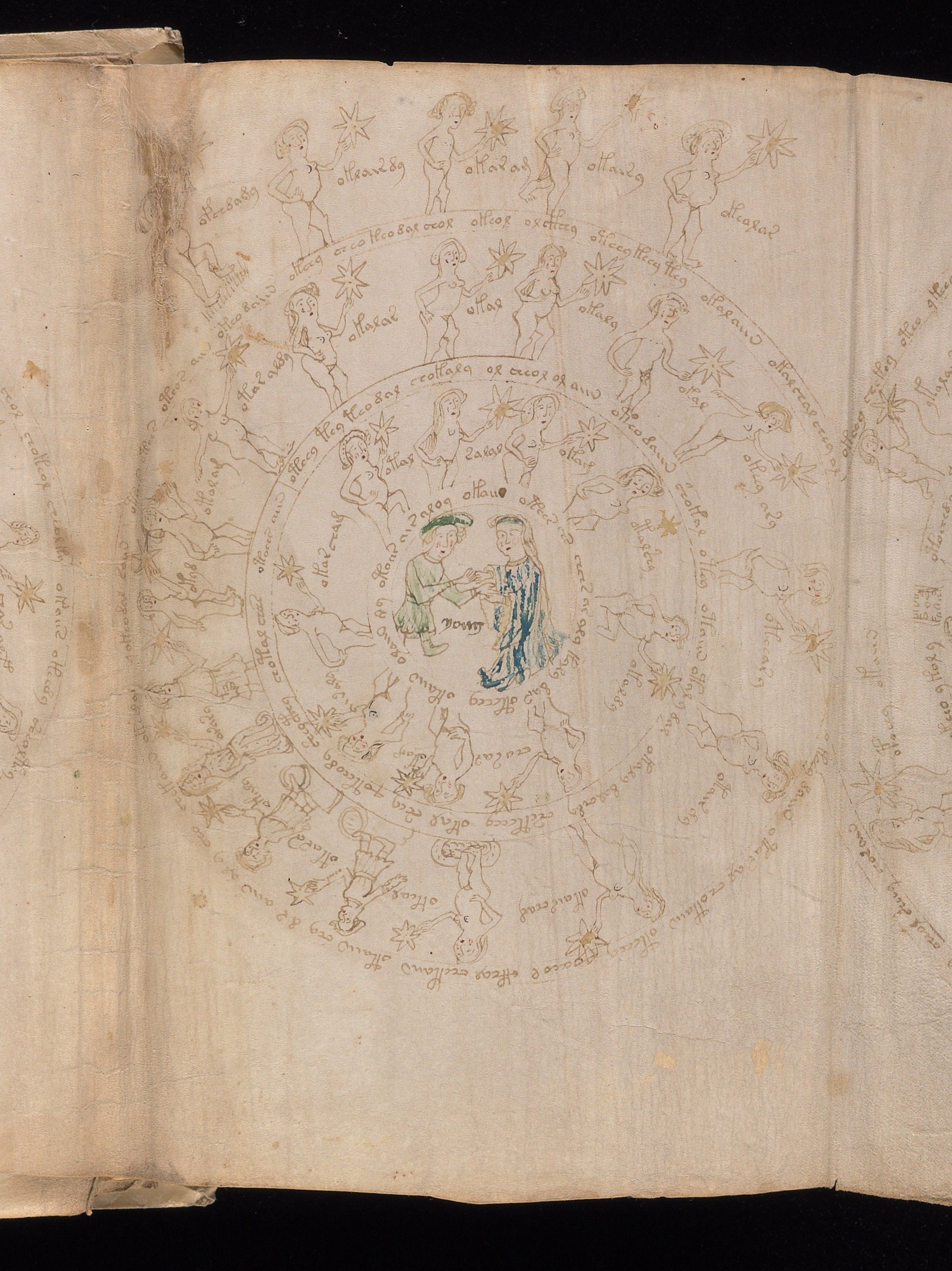
Scorpio (f73r) and Gemini (f72r2), the pages that carry the 1408 and 1415 eclipse marks
Every eclipse 1395–1445 matched to its zodiac figure and recorded marks
f68r3The Moon in the Pleiades
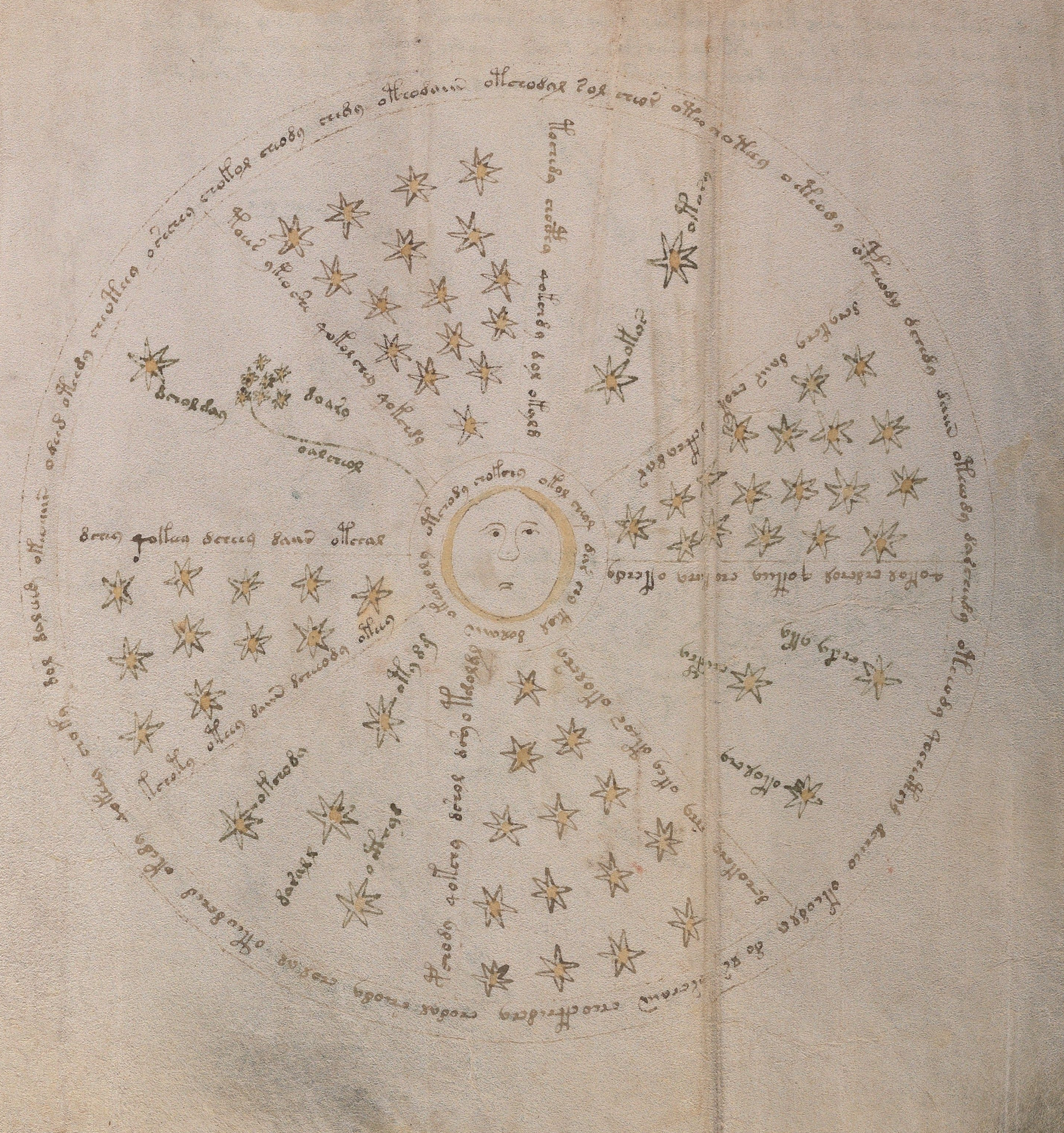
f68r3: the Moon entering the Pleiades, Beinecke MS 408
The third star chart draws the Moon as a full round face beside a cluster of seven stars — the other two charts draw a crescent. In the 1400s a full Moon could stand in the Pleiades only in early November, Julian, and only in the years the Moon's path reached the cluster.
| Date (Julian) | From Alcyone | Lit | Moon's altitude | Day's field cell |
|---|---|---|---|---|
| 1412-11-17 | 0.24° | 99.0% | 19.5° | 54 LOVE |
| 1413-11-08 | 0.29° | 99.4% | 60.8° | 153 ALBERT EINSTEIN |
| 1429-11-10 | 0.35° | 99.8% | 35.2° | 88 ONE LOVE |
| 1429-12-08 | 0.01° | 95.5% | 17.6° | 116 BYZANTINE |
| 1430-10-31 | 0.41° | 99.9% | 54.8° | 186 LINUS TORVALDS |
| 1431-10-22 | 0.54° | 95.6% | 30.1° | 28 SHA |
| 1432-11-07 | 0.03° | 99.8% | 62.0° | 153 ALBERT EINSTEIN |
Over 1380–1460 the Moon's disc crossed the cluster only in four runs: 1392–1396, 1410–1414, 1429–1433 and 1447–1452. The 1410–1414 run sits between the December 1408 gathering and the total eclipse of 1415.
moon_pleiades.json — every passage of the Moon by Alcyone 1380–1460 as seen from Prague